The Discomfort is the Point

Hanneke Lourens builds furniture from the textures of a country that never leaves you alone. There is a particular kind of seeing that belongs to people raised in landscapes of contradiction. Not the romantic contradiction of travel brochures but the real kind, the kind where corrugated iron catches sunlight so precisely it becomes sculpture and […]

The Discomfort is the Point

Hanneke Lourens builds furniture from the textures of a country that never leaves you alone.

There is a particular kind of seeing that belongs to people raised in landscapes of contradiction. Not the romantic contradiction of travel brochures but the real kind, the kind where corrugated iron catches sunlight so precisely it becomes sculpture and security bars on a Johannesburg window arrange themselves into geometries European minimalists spend entire careers trying to invent. Hanneke Lourens saw all of it. She still does.

The South African-born, Northern California-based furniture designer has – across three collections since 2024 – built a body of work that refuses the most convenient version of its own story. It’s not African-inspired design in the way the industry typically packages it with no mud cloth upholstery nor token pattern. Lourens works in white oak, walnut, ash, and salvaged old-growth redwood. Her references are structural, spatial, and stubbornly specific as seen in the corrugated metal sheeting defining South Africa’s urban and peri-urban landscape. It’s seen in the stainless-steel burglar bars bolted to facades in every neighbourhood from Sandton to Khayelitsha and in the improvised public seating on sidewalks where the state never bothered to provide benches.

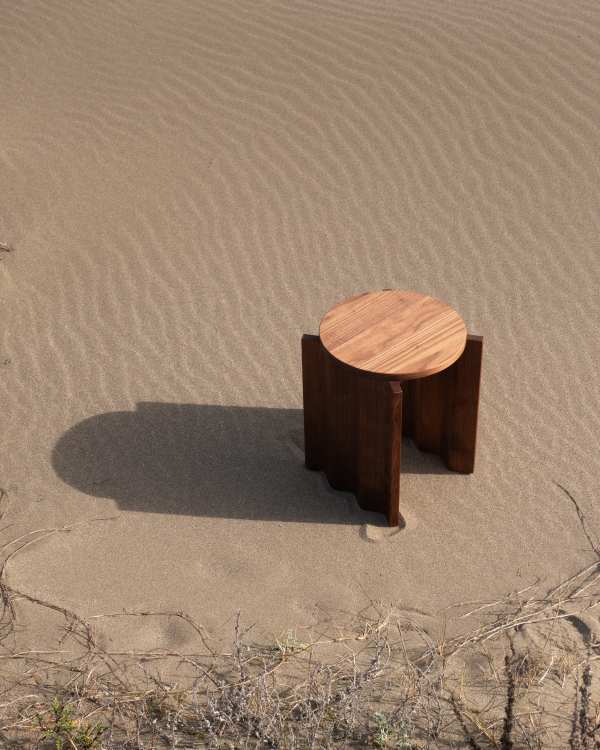
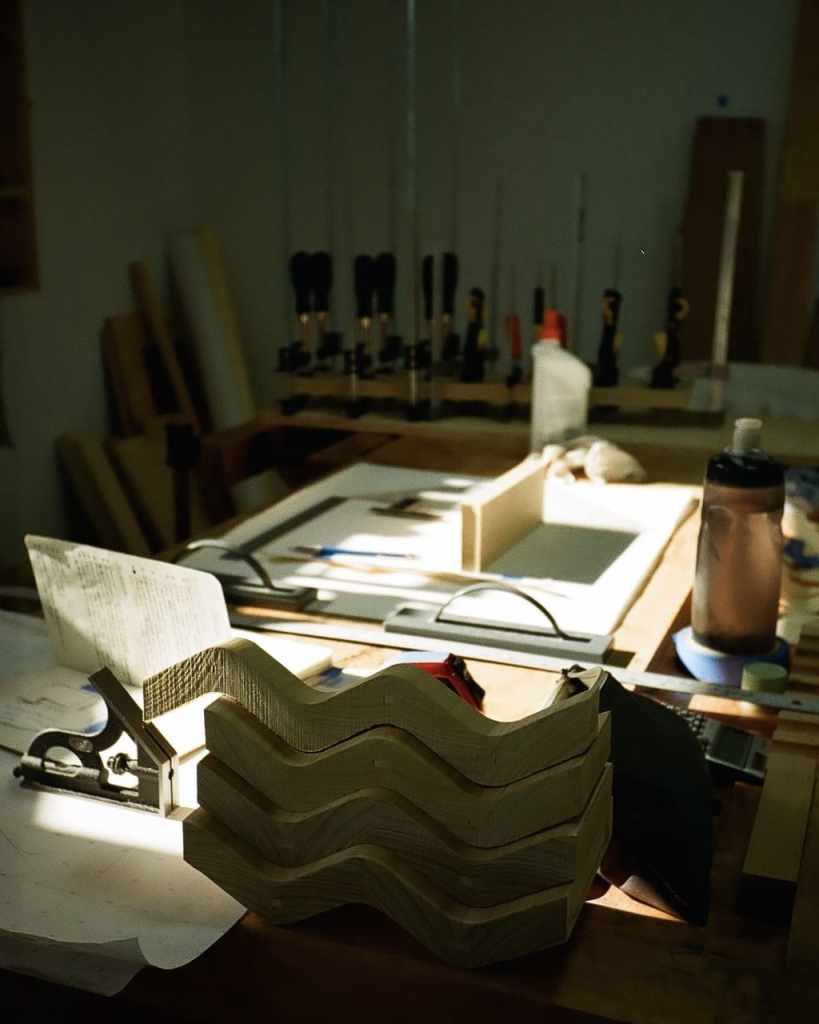
Her debut, the Corrugated Collection, translated the undulating profile of zinc sheeting into hand-carved oak curves: five pieces oscillating between Brutalist weight and the kind of lightness that only comes from knowing exactly where to remove material. Each wave in the wood serves the same purpose it serves in metal: structural integrity through shape. The collection announced a designer whose sophistication lives in logic, not flourishing.

The Leftover Bench that followed stripped the work back even further. Crafted entirely from reclaimed redwood – posts salvaged from a demolished building in Cloverdale and planks milled from a tree abandoned on a forest floor since the late 1800s – the bench is a deliberate collision of two worlds, its form mimicking makeshift communal seating found across South African streets via a stool, a chair, and a bench pushed together by necessity. Darkened nail holes from previous construction are left visible, not as an aesthetic detail but as biography. The wood remembers what it was before, Lourens having presented it at Works In Progress III during San Francisco Art Week. Positioned on a clifftop above the Pacific as a piece born from the spatial inequality of Apartheid-era planning, it looked out over a coastline where designed outdoor furniture is so abundant it disappears into the scenery.

Her most recent work, the Barred Collection, is perhaps the most confrontational: four walnut and ash pieces interrupted by slim stainless-steel bars with tabs and screws connecting columns, deliberately imitating the security infrastructure marking nearly every building in South Africa. The Barred Chair uses a cubed steel grid as its backrest, the Barred Coffee Table built from salvaged old-growth redwood and wearing its chunky legs dotted with darkened nail holes like evidence. The steel catches light the way jewellery does, exactly the tension Lourens is engineering: protection as ornamentation, anxiety as aesthetic.

What makes this work matter beyond the objects themselves is its methodology. Lourens isn’t translating African materiality for a Western audience. She’s insisting the design intelligence embedded in everyday South African environments – the structural ingenuity of informal construction, unintentional beauty of security architecture, and communal problem-solving of streetside furniture – constitutes a design language as rigorous and worthy of elevation as anything taught at a European institution. Having trained at a traditional woodworking school, she now works out of a converted cow barn in the redwoods and hand-builds every piece. The craft is impeccable, but the ideas come from home.

That’s a distinction worth holding onto. Innovation, in an African context, has never required permission but instead simply recognition.

“Protection as ornamentation, anxiety as aesthetic.”