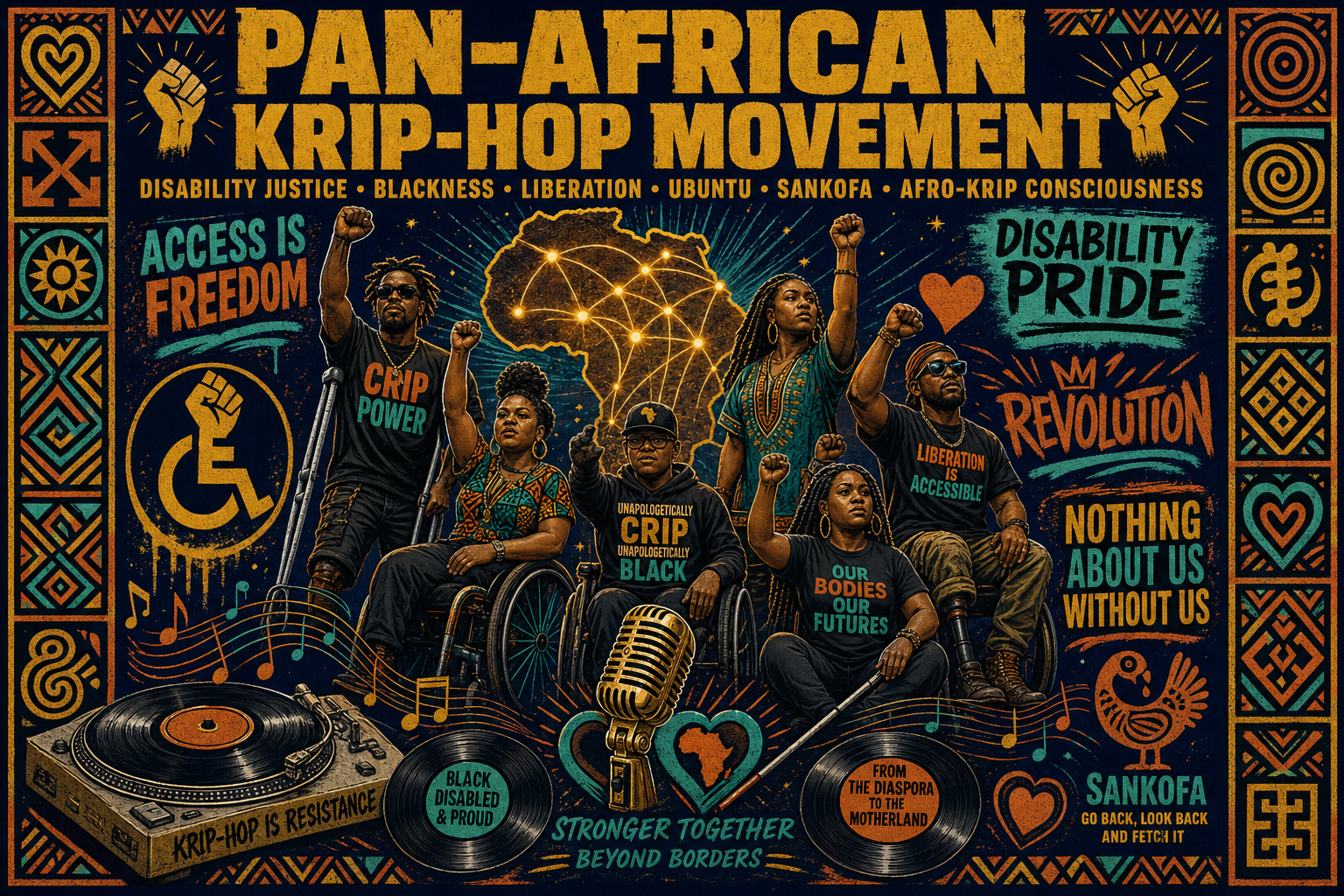
A Pan-African Krip-Hop Movement would represent a new stage in Black cultural and political organizing by placing Black disabled people at the center of, SPan-African liberation struggles. Rooted in Hip-Hop culture, disability justice, Ubuntu, Sankofa, and Pan-African thought, such a movement would connect Black disabled artists, activists, scholars, and community organizers throughout Africa and the African diaspora. While traditional Pan-African movements have often focused on race, colonialism, and economic exploitation, a Pan-African Krip-Hop Movement would expand these conversations by examining how ableism has also shaped the lives of Black people across the globe. In doing so, it would argue that Black liberation cannot be achieved without confronting the exclusion and marginalization of Black disabled people.
This movement would build upon the intellectual foundations established by thinkers such as Marcus Garvey, Kwame Nkrumah, Frantz Fanon, and Walter Rodney. However, it would extend their work by centering disability as a crucial site of analysis and resistance. Drawing from Fanon’s critique of colonialism, a Pan-African Krip-Hop Movement would argue that colonial powers not only imposed racial hierarchies but also introduced rigid notions of normalcy, productivity, intelligence, and bodily value. These colonial definitions continue to influence Black communities today through internalized ableism and the exclusion of disabled people from leadership, cultural production, and political movements. Therefore, decolonization must involve more than the dismantling of racism; it must also challenge the ableist structures that continue to shape Black life.
Across the African continent, a Pan-African Krip-Hop Movement would create networks among disabled artists and activists who use culture as a tool for social transformation. In countries such as South Africa, Zimbabwe, Ghana, Nigeria, and Kenya, local chapters could organize Hip-Hop festivals, poetry events, disability arts exhibitions, and political education programs that address both disability rights and broader struggles for social justice. In Zimbabwe, the work of Dr. Joshua Teke Malinga would stand as a powerful example of this vision, as his advocacy for disability rights, inclusive policy, and the political recognition of disabled people has helped shape national conversations about justice and representation. Through music, spoken word, dance, visual art, and storytelling, Black disabled Africans would document their experiences while creating new visions of freedom rooted in African cultural traditions and disability pride. These artistic practices would serve as both historical archives and political interventions, challenging stereotypes that portray disabled Africans as objects of charity rather than agents of change.
The movement would also strengthen connections throughout the African diaspora. Black disabled communities in the United States, Canada, Brazil, the Caribbean, Europe, and Africa would engage in cultural exchanges designed to share knowledge, strategies, and creative practices. Through international conferences, digital gatherings, collaborative recordings, and documentary projects, participants would explore common experiences while recognizing the distinct histories of each community. Such exchanges would foster what might be called Afro-Krip consciousness—a collective awareness that Black disabled people across the world are linked through shared struggles against racism, ableism, poverty, colonialism, and social exclusion.
The San Francisco Bay Area would serve as a particularly important site within this global movement. The Bay Area possesses a unique history of disability rights activism, Black liberation organizing, radical cultural production, and Hip-Hop innovation. It is therefore an ideal location for developing the institutional and community foundations of a Pan-African Krip-Hop Movement. In Oakland, Berkeley, Richmond, and San Francisco, Black disabled artists and activists could create community spaces dedicated to political education, mutual aid, cultural preservation, and leadership development. These spaces would host workshops on Black disability history, reading groups on Fanon’s decolonization and Robinson’s the Black Radical Tradition, oral history projects, and artistic collaborations that bring together local and international participants.
The arts would remain central to the movement’s vision. Hip-Hop, poetry, film, radio, graffiti, theater, and digital media would function as tools for education and resistance. Through these artistic forms, Black disabled people would challenge dominant narratives about disability while creating alternative representations grounded in dignity, creativity, and collective power. International collaborations linking Oakland with Cape Town, Harare, São Paulo, London, and Toronto would allow artists to exchange stories and produce new cultural works that reflect the diversity of Black disabled experiences across the diaspora. These collaborations would also contribute to the preservation of Black disability histories that have too often been ignored within both mainstream disability studies and traditional Black historical narratives.
Within the framework of Krip-Hop Theory, a Pan-African Krip-Hop Movement would represent the practical expression of the Black Krip Radical Tradition. If Cedric Robinson’s Black Radical Tradition illuminates the ways Black communities resisted racial capitalism and oppression, the Black Krip Radical Tradition reveals how Black disabled people have simultaneously resisted racism, ableism, colonialism, and economic exploitation. It highlights the cultural knowledge, political strategies, and survival practices developed by Black disabled communities across generations. Rather than viewing disability as a limitation, the movement would understand disability as a source of political insight, cultural innovation, and revolutionary possibility.
Ultimately, a Pan-African Krip-Hop Movement would seek to transform both Pan-Africanism and disability justice. It would insist that Black disabled people are not peripheral figures within Black liberation struggles but central participants whose experiences expand our understanding of freedom itself. By connecting activism and artistic expression across Africa and the diaspora, the movement would create new possibilities for solidarity, self-determination, and collective liberation. Through the power of Hip-Hop and the vision of Afro-Krip consciousness, a Pan-African Krip-Hop Movement would work toward a future in which Black disabled people are recognized not only as survivors of oppression but also as leaders, theorists, artists, and architects of a more just world.


 Black News