Who Decides What Your Vehicle Is Worth and Where’s the Proof?
A vehicle bought for EC$225,000 and valued at EC$120,000 three years later has prompted former senior insurance executive Royron Adams to question how vehicle values are determined in Saint Lucia—and whether motorists can see the evidence behind figures that could affect their insurance claims, loans and resale proceeds. Adams, who has more than 30 years […] The post Who Decides What Your Vehicle Is Worth and Where’s the Proof? appeared first on Saint Lucia Daily Post.
 Black News
A vehicle bought for EC$225,000 and valued at EC$120,000 three years later has prompted former senior insurance executive Royron Adams to question how vehicle values are determined in Saint Lucia—and whether motorists can see the evidence behind figures that could affect their insurance claims, loans and resale proceeds.
Adams, who has more than 30 years of experience in Caribbean insurance and financial services, is calling for greater transparency, warning that unexplained valuations could leave consumers, banks and insurers financially exposed.
“One number decides the claim, the loan and the sale price. Why is it optional, and why does it need no explanation?” he questioned.
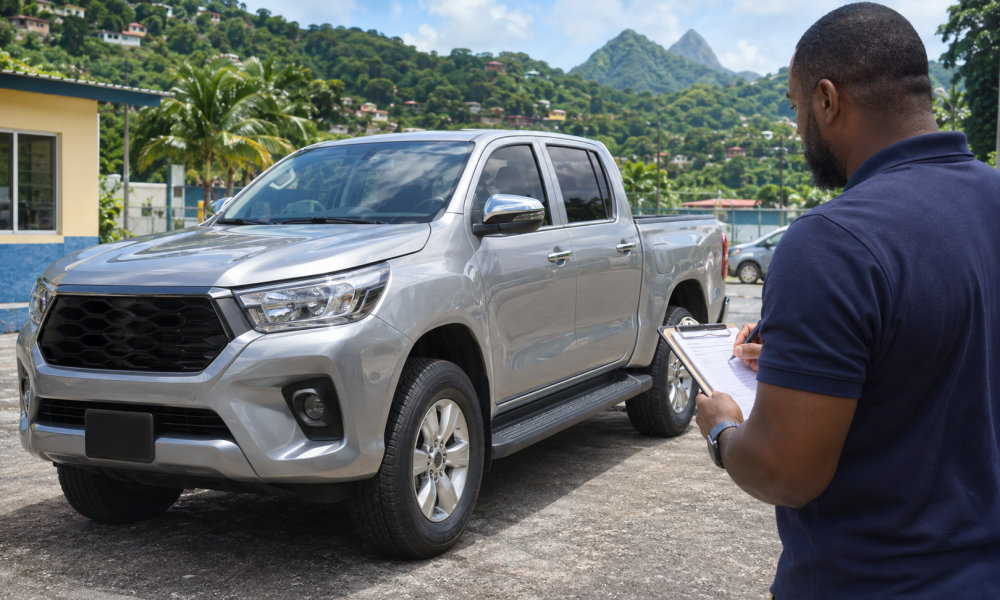
At the centre of his concerns is a Toyota Hilux he said he purchased brand new from a local dealership for EC$225,000 in November 2023. Three years later, he said, the vehicle was valued at EC$120,000—a reduction of EC$105,000, or approximately 46.7 per cent.
According to Adams, the pickup had covered just 24,264 kilometres, had been serviced by the dealership and showed no evidence of accident damage or rust.
He said the assessment did not provide depreciation calculations, comparable market sales or an explanation of how the vehicle’s mileage, service history and condition influenced the final figure.
“I am not saying the figure is wrong. I am saying nobody can show that it is right. Not the valuer, not my insurer, not a bank, and not me,” he stated.
For motorists, Adams argues, the consequences could become apparent when a vehicle is written off and the insurance settlement falls short of the cost of purchasing a comparable replacement.
Using international depreciation benchmarks and adjustments for mileage, he calculated an alternative estimated value of approximately EC$164,000 for his vehicle—EC$44,000 above the assessment.
That figure represents Adams’s estimate rather than an independently verified local market valuation. He argues, however, that the difference demonstrates why motorists should be able to understand and scrutinise the basis of an assessment.
If the higher estimate reflected the cost of a comparable replacement, a motorist insured for EC$120,000 could face a substantial funding gap following a total loss, depending on the policy’s terms and settlement provisions.
Adams also raised the opposite concern: motorists whose vehicles are overvalued could pay higher premiums without necessarily receiving a corresponding benefit when making a claim.
He warned that lower assessed values could affect decisions about whether damaged vehicles should be repaired or declared total losses, particularly when parts and labour remain expensive.
The questions extend beyond insurance to the loans motorists may still be repaying.
In an illustrative calculation involving a fully financed EC$225,000 vehicle, a seven-year loan and an annual interest rate of 7.5 per cent, Adams estimated that approximately EC$142,700 would remain outstanding after three years.
Against a vehicle valuation of EC$120,000, that would leave a potential gap of approximately EC$22,700 between the outstanding debt and the assessed security value, before any forced-sale discount or recovery costs.
His broader concern is whether the figures used to support lending and insurance decisions adequately reflect the vehicles being assessed—and whether those figures can be explained.
Adams is calling for insurers, commercial banks, dealerships, assessors and regulators to establish a more transparent and standardised approach.
His recommendations include disclosure of valuation methods, clearly defined depreciation schedules, adjustments for mileage and condition, and a shared industry database of actual vehicle sale prices and insurance settlements.
He also wants assessments to distinguish clearly between open-market, trade-in and forced-sale values, which serve different commercial purposes.
While acknowledging that overseas vehicle prices cannot simply be applied to Saint Lucia because of differences in taxation and market conditions, Adams maintains that locally relevant evidence should underpin valuations.
“None of this needs new technology. It needs an industry that stops accepting numbers it cannot explain,” he stated
The post Who Decides What Your Vehicle Is Worth and Where’s the Proof? appeared first on Saint Lucia Daily Post.