African leaders demand fairer global trade rules as France backs Nairobi declaration
African leaders and France have adopted a sweeping economic and geopolitical declaration calling for a transition away from extractive trade models, warning that global economic distortions are undermining the continent’s industrial ambitions.
 Black News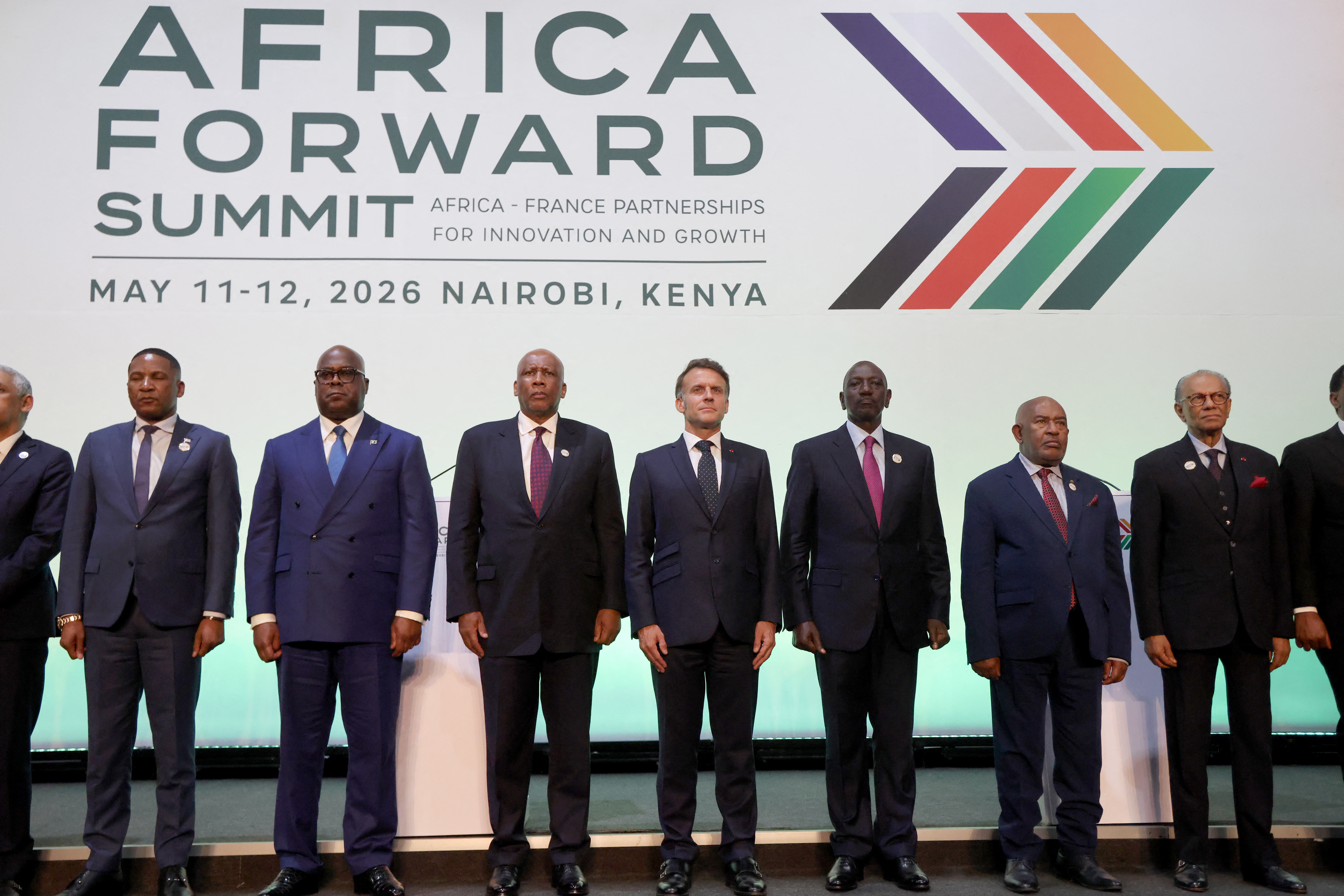
![Botswana's President Duma Boko, President of the Democratic Republic of the Congo Felix Tshisekedi, Lesotho's King Letsie III, France's President Emmanuel Macron, Kenya's President William Ruto and Comoros' President Azali Assoumani pose for a Family photo following the closing plenary at the Africa Forward summit in Nairobi on May 12, 2026. [Photo by Ludovic MARIN / AFP via Getty Images]](https://ocdn.eu/pulscms/MDA_/473529e6cf3237e4aa75cfaf35520027.jpg)
African leaders and France have adopted a sweeping economic and geopolitical declaration calling for a transition away from extractive trade models, warning that global economic distortions are undermining the continent’s industrial ambitions.
- African leaders and France have adopted a new declaration to reshape economic and strategic relations amid rising global uncertainty.
- The agreement pushes for Africa’s transition from raw commodity exports to industrialisation and local value addition.
- Leaders also called for reforms to the global financial system, citing debt pressures and unequal trade dynamics.
- The summit placed strong emphasis on AI sovereignty, digital infrastructure, renewable energy, and regional economic integration.
The declaration, released following the Africa Forward Summit in Nairobi and shared on Wednesday, May 13, 2026, through the verified X account of William Ruto, outlines a joint framework covering industrialisation, artificial intelligence, debt reform, green energy, health systems, maritime security, and trade integration.
At the centre of the agreement is a growing African push for economic sovereignty, with governments calling for a shift from dependence on raw commodity exports toward local manufacturing, processing, and regional value chains.
The declaration states that Africa’s natural resources, including critical minerals, “should serve as catalysts for local value addition, beneficiation, and job creation on the continent.”
Leaders also warned that global “structural overcapacities” and “distortive non-market policies and practices” are depressing commodity prices, discouraging industrial investment, and weakening the competitiveness of emerging African industries.
Debt and trade tensions
![French President Emmanuel Macron and Kenyan President William Ruto participate in a panel on culture during the Africa Forward Summit in Nairobi, Kenya, on May 11, 2026. [Photo by Lucas Mukasa/Anadolu via Getty Images]](https://ocdn.eu/pulscms/MDA_/73952290ca7b921feb5236fd51889ef1.jpg)
While the document does not explicitly name countries, its language reflects mounting concern among African economies about increasingly fragmented global trade dynamics and competition among major economic powers.
The summit declaration further calls for stronger African participation in global financial governance, including reforms to the International Monetary Fund (IMF) and the wider international debt architecture.
African governments argued that rising sovereign debt burdens, expensive borrowing costs, and limited access to affordable long-term financing continue to constrain development.
Africa’s AI ambitions
![France's President Emmanuel Macron (R) and Kenya's President William Ruto (L) look at an Artificial Intelligence (AI) film made by film-makers from the Creation Africa program during the Africa Forward summit in Nairobi on May 11, 2026. [Photo by Ludovic MARIN / AFP via Getty Images]](https://ocdn.eu/pulscms/MDA_/9722511da08767d1fd3628d4dfeeb0ef.jpg)
The agreement also places unusual emphasis on digital sovereignty and artificial intelligence, signalling Africa’s intent to secure greater control over data infrastructure and emerging technologies.
Participating states are committed to supporting African-led ownership of AI systems, local language models, regional data centres, and open-source digital infrastructure while reducing dependence on concentrated global technological power.
The focus on AI comes as governments worldwide race to establish influence over artificial intelligence governance, semiconductor supply chains, and digital infrastructure investment.
Beyond technology, the declaration outlines plans for deeper cooperation on green industrialisation, renewable energy, maritime economies, vaccine manufacturing, and regional trade integration under the African Continental Free Trade Area.
The summit also highlighted growing geopolitical anxieties. In a separate peace and security declaration, participating leaders rejected “external interference” and the “privatisation of security by external operators,” language likely to attract international attention amid expanding foreign security involvement across parts of Africa.
The Nairobi gathering brought together African heads of state, French officials, and representatives from institutions including the IMF, the World Bank, the African Development Bank, the European Investment Bank, and other development agencies.
The declaration is expected to inform broader discussions ahead of the upcoming G7 and international financing meetings later this year, where African governments are seeking greater influence over trade, debt, and climate financing decisions.