

After losing its top title, Africa’s second-largest manufacturer eyes $46 billion to initiate a massive industrial comeback
South Africa intends to draw in $46 billion (750 billion rand) for an industrial push to establish initiatives classified as specialized industrial hubs.
 Black News

South Africa intends to draw in $46 billion (750 billion rand) for an industrial push to establish initiatives classified as specialized industrial hubs.
- South Africa aims to attract $46 billion in investments by April next year to boost its manufacturing sector through specialized industrial hubs.
- The government plans to raise about R200 billion from various funding sources, leveraging investment pledges made earlier in the year.
- President Cyril Ramaphosa highlighted a record R890 billion in investment commitments, with much of it intended for special economic zones and related industrial projects.
- South Africa's manufacturing sector has faced significant setbacks, including being surpassed by Morocco in industrial output and car manufacturing.
The country intends to meet this investment target by April next year, barely a year from now, as it hopes to immediately plug the holes that have been festering for decades in its manufacturing sector.
“We are targeting R750 billion ($46 billion) worth of investments in this current fiscal year,” Maoto Molefane, acting deputy director-general at the Department of Trade, told Bloomberg News on the sidelines of the Special Economic Zones (SEZs) investment conference in Durban on Thursday.
The country’s Department of Trade, Industry, and Competition plans to raise around R200 billion through a combination of infrastructure funding, development finance institutions, commercial lenders, and investment promises made during the country's investment conference earlier this year.
DON’T MISS THIS: South Africa's producer inflation hits a record high surge not seen in 16 years
According to the country’s president, Cyril Ramaphosa, investors pledged a record R890 billion ($54 billion) during the event, with a large portion likely to fund projects in special economic zones (SEZs) and other important industrial initiatives.
The government regards the recovery of manufacturing as a fundamental component of its long-term economic strategy, with SEZs playing a key role in attracting investment, boosting industrial capacity, and generating employment.
Manufacturing's contribution to South Africa's economy has progressively declined over the last three decades, from 24% of GDP in 1994 to around 11% now, as seen on Bloomberg.
Some of South Africa’s manufacturing struggles
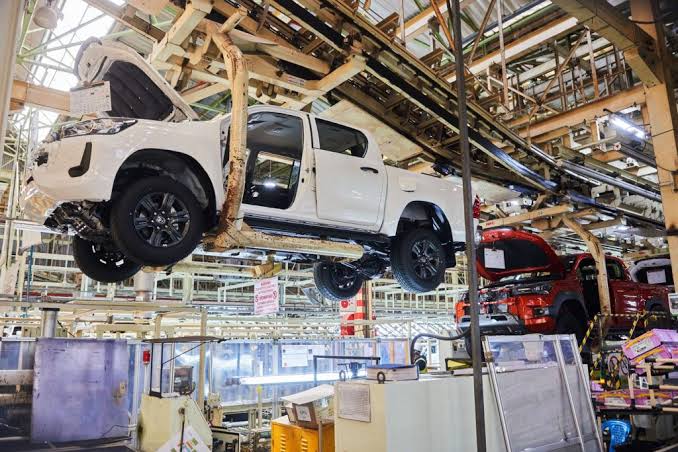
While the South Africa’s manufacturing sector has recorded some major wins in recent months, including recording a 3 times surge in weapons exports to countries like Turney and France, from $190 million (R3.6 billion) in 2024, to $550 million (R10 billion) in 2025, emerging as a production base for Chinese brand Jetour’s T1 and T2 SUV models, and most recently drawing in $633m investment from Japan's largest car company, Toyota, the sector has seen its own fair share of struggles.
In May 2026, Morocco overtook South Africa as Africa’s leading industrial economy, according to a report by the African Development Bank.
This would hardly be the first time Morocco is overtaking South Africa in a manufacturing index.
Earlier in the year, reports showed that South Africa lost its spot as Africa’s top car manufacturing country to Morocco.
The report showed that Morocco produced one million vehicles by early December 2025, representing an increase of about 79% from the 559,645 units manufactured in the full year of 2024.
In contrast, South Africa’s total vehicle sales from January to December 2025 came in at 596,818 units, a 15.67% increase from 515,976 in 2024, but slightly lower than Morocco’s output.
By the end of 2025, South Africa’s manufacturing sector was said to be facing a steep slowdown, with business sentiment dropping to levels not seen since the country’s Covid-19 lockdowns.
In the space of two years, 5000 jobs had been lost in the sector.
In the same month, South Africa’s last remaining manganese smelting operation was said to be at risk of closure as surging electricity costs disrupted the energy-intensive facility.
By April 2026, South Africa lost out on a $45 million expansion by Japanese car company Nissan to Egypt as a preferred manufacturing hub.
Earlier in January, a report showed that South Africa’s automotive industry was under pressure as cheap Chinese vehicles flooded the market.











![[NOUVELLE CONSTITUTION RETOQUÉE SUR SAISINE DU PR DIOMAYE, RÉFÉRENDUM ABANDONNÉ – Par Ousseynou Nar Gueye] REJET DE LA LOI 18-2026 : LA VICTOIRE DU DROIT SUR L’URGENCE POLITIQUE](https://nations-sn.com/wp-content/uploads/2026/07/ARticle-8-PHOTO-D-ILLUSTRATION.png)


