Elliot Tuttle on His Thrillingly Provocative 'Blue Film'
The word “faggot” is uttered upwards of thirty times in Elliot Tuttle’s Blue Film.Never as a slur, unless we are choosing to categorize alpha male degradation as hate speech. And only said by queer characters.That’s partially because there aren’t any straight characters to speak of, just stars Kieron Moore (Boots) and Reed Birney (Mass) in an unrelenting two-hander. The film follows findom camboy Aaron Eagle (Moore) as he visits a masked high-paying client (Birney) who soon reveals himself to be his middle school English teacher, disgraced and fired for past crimes.Mild spoilers for Blue Film follow.What follows is a series of startling (and disturbingly) honest conversations between the two, forced into an aberrant intimacy by way of their shared past.Infamously rejected from the big-name festivals like Sundance and SXSW that tend to “break” new films and filmmakers, in the traditional sense, Blue Film harkens back to an era where art about sex, especially queer art about sex, feels genuinely transgressive. Dangerous, even. Where sitting in discomfort and confronting taboos head-on is par for the course, without all that hemming and hawing the Internet age is dubbing “discourse.”An era of artistic faggotry, if you will.As with many of the all-time greats, Tuttle’s film has inspired no shortage of walkouts during its festival run, which began last August at the Edinburgh International Film Festival. It’s a dynamic the filmmaker has taken in stride, leaning into his film’s more abrasive tendencies throughout the marketing and press campaigns (distributor Obscured Releasing handed out matchbooks stamped “what’s up faggots?” at the screening event PAPER attended.)Even the title is a wink in that direction, alluding to theories of Hayes-era censors marking up taboo film strips with blue grease pencil. The film itself is a markedly more subdued affair than all this fanfare might suggest, loaded with a disarming sense of humanism. There’s nothing particularly graphic to balk at, all the danger instead lying in the words and ideas we’d rather not talk about. PAPER caught an advance screening of the film last week at Los Angeles’ Vidiots (a theater Tuttle previously managed) and sat down with the filmmaker to discuss one of the most auspicious, singular debuts in recent memory.This interview has been edited and condensed for clarity.As I walked in, Lana del Rey’s “A&W” was playing. What was your process in making the preshow playlist?Cultivating the vibe. Kieron and I bonded a lot over our love of Lana Del Rey. I think A&W is easily in her top five songs. I can talk specifically about a couple of songs because I did curate it for a long time. “When Love Is Young” by The Free Design, kind of the film’s theme. [The song features extensively and diegetically in the film.] A couple of other songs that could have been if we had a different budget were “In My Life” by The Beatles and “When You Were Young” by the Killers. New Order’s “Leave Me Alone” and Celine Dion’s “The Power of Love”, these two kind of aching songs about loneliness. Ethel Cain’s “Gibson Girl,” this very insidious, sexy song. I also made the playlist for our afterparty for the New York screening, which is much more of a party vibe.What’s your favorite pull on that one?There's a song called “Sex Dealer” by Six Sex. They’re all bangers on that one. “Sex Dealer,” perfect partying song for after a movie about upsetting sex. It's hard to curate the party vibe after this movie. Once people get out of the theater it is hard to want to go out and drink and celebrate the release of the film. You have to get people back in the mood to be social and have fun.What have people’s vibes been in the immediate aftermath of a screening? It's so varying. People are definitely a little depressed, but I also find a lot of people feeling very moved. Some people angry. I’m finding new vibes every day in movie theater lobbies after we screen.Have you had any interactions that are particularly unexpected or have stuck with you?The only thing that really is unexpected every time is how varied the reactions are. But there was one person after the screening in Edinburgh.. he was like, ‘My heart is racing. I don't know what to–’ very worked up. I think his words were, ‘if they took an EKG of my heart right now…’ and I could hear his voice shaking a little bit.It was our first time showing the film, and seeing someone have a more visceral reaction to the film was kind of shocking and jarring to me. In an interesting way, not in a terrible way. Yes, the film is sometimes upsetting or whatever, but seeing someone visibly nervous or worked up was a shock to me.Have you had a conversation with anyone who has walked out? No, but I would love to, and not even because I would try to convince them to watch the rest of the movie.I think if you wanna walk out of the movie, totally do it. I have just not been in the vicinity to catch someone. And honestly, they might not wanna talk to me if t
 Black News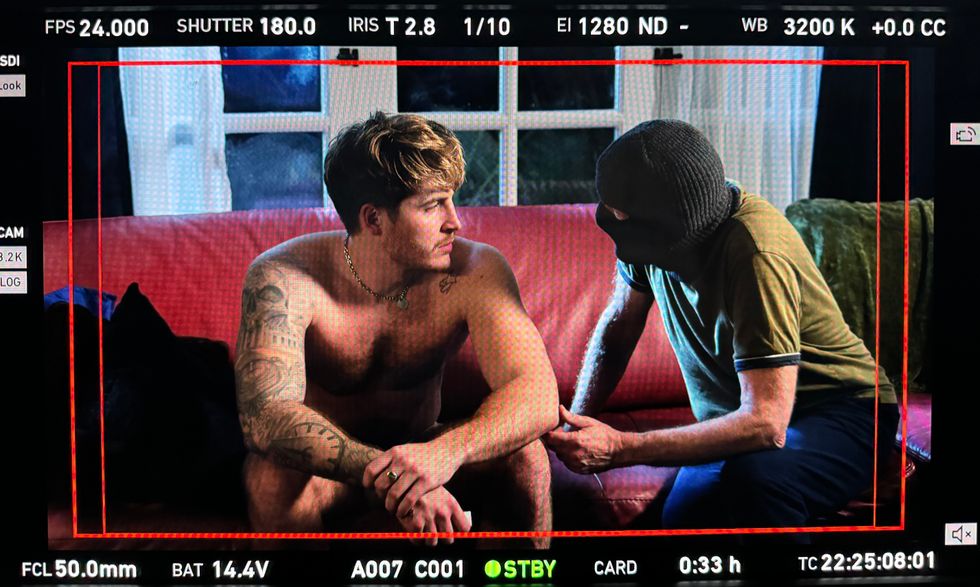
The word “faggot” is uttered upwards of thirty times in Elliot Tuttle’s Blue Film.
Never as a slur, unless we are choosing to categorize alpha male degradation as hate speech. And only said by queer characters.
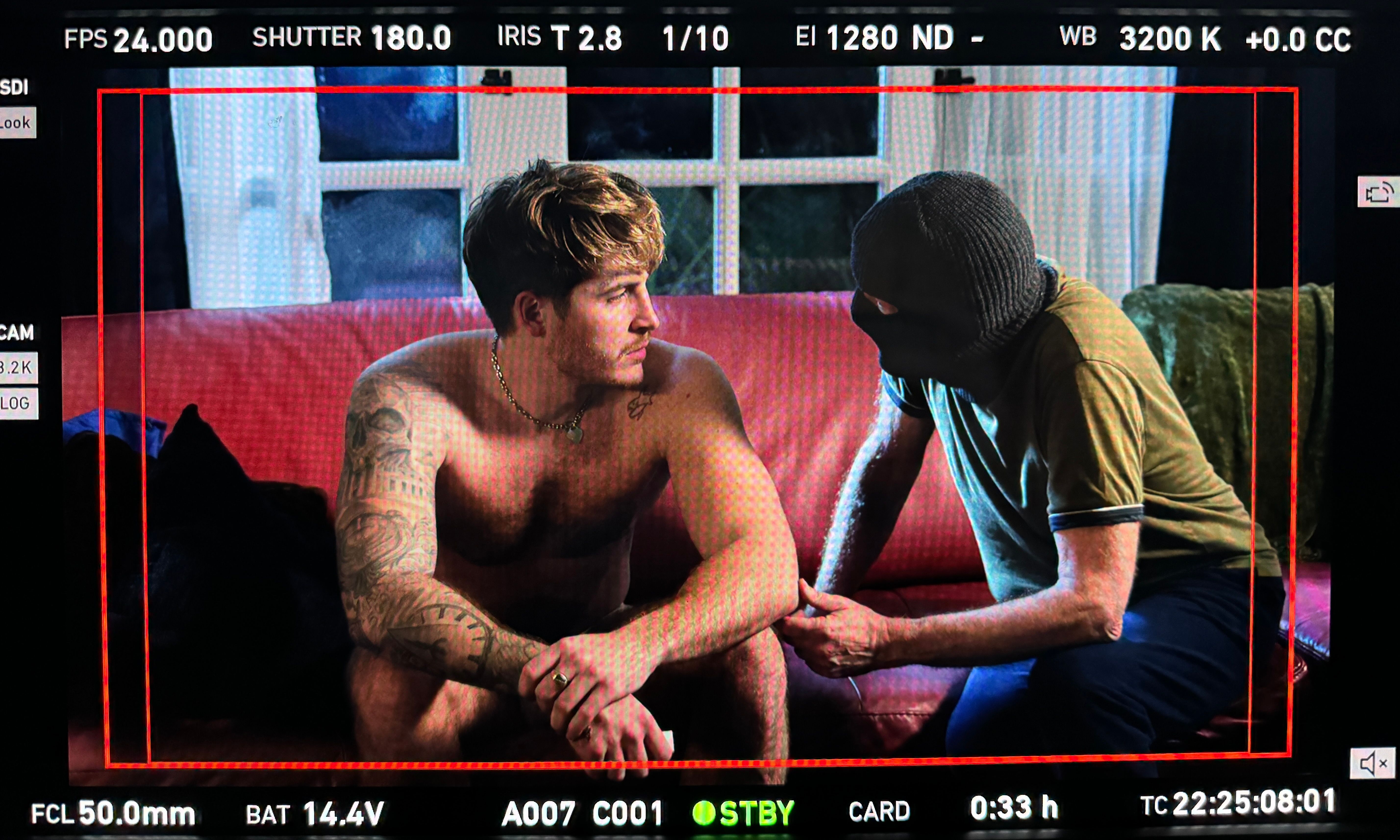
That’s partially because there aren’t any straight characters to speak of, just stars Kieron Moore (Boots) and Reed Birney (Mass) in an unrelenting two-hander. The film follows findom camboy Aaron Eagle (Moore) as he visits a masked high-paying client (Birney) who soon reveals himself to be his middle school English teacher, disgraced and fired for past crimes.
Mild spoilers for Blue Film follow.
What follows is a series of startling (and disturbingly) honest conversations between the two, forced into an aberrant intimacy by way of their shared past.
Infamously rejected from the big-name festivals like Sundance and SXSW that tend to “break” new films and filmmakers, in the traditional sense, Blue Film harkens back to an era where art about sex, especially queer art about sex, feels genuinely transgressive. Dangerous, even. Where sitting in discomfort and confronting taboos head-on is par for the course, without all that hemming and hawing the Internet age is dubbing “discourse.”
An era of artistic faggotry, if you will.
As with many of the all-time greats, Tuttle’s film has inspired no shortage of walkouts during its festival run, which began last August at the Edinburgh International Film Festival. It’s a dynamic the filmmaker has taken in stride, leaning into his film’s more abrasive tendencies throughout the marketing and press campaigns (distributor Obscured Releasing handed out matchbooks stamped “what’s up faggots?” at the screening event PAPER attended.)
Even the title is a wink in that direction, alluding to theories of Hayes-era censors marking up taboo film strips with blue grease pencil.
The film itself is a markedly more subdued affair than all this fanfare might suggest, loaded with a disarming sense of humanism. There’s nothing particularly graphic to balk at, all the danger instead lying in the words and ideas we’d rather not talk about.
PAPER caught an advance screening of the film last week at Los Angeles’ Vidiots (a theater Tuttle previously managed) and sat down with the filmmaker to discuss one of the most auspicious, singular debuts in recent memory.
This interview has been edited and condensed for clarity.
As I walked in, Lana del Rey’s “A&W” was playing. What was your process in making the preshow playlist?
Cultivating the vibe. Kieron and I bonded a lot over our love of Lana Del Rey. I think A&W is easily in her top five songs. I can talk specifically about a couple of songs because I did curate it for a long time. “When Love Is Young” by The Free Design, kind of the film’s theme. [The song features extensively and diegetically in the film.] A couple of other songs that could have been if we had a different budget were “In My Life” by The Beatles and “When You Were Young” by the Killers.
New Order’s “Leave Me Alone” and Celine Dion’s “The Power of Love”, these two kind of aching songs about loneliness. Ethel Cain’s “Gibson Girl,” this very insidious, sexy song. I also made the playlist for our afterparty for the New York screening, which is much more of a party vibe.
What’s your favorite pull on that one?
There's a song called “Sex Dealer” by Six Sex. They’re all bangers on that one. “Sex Dealer,” perfect partying song for after a movie about upsetting sex. It's hard to curate the party vibe after this movie. Once people get out of the theater it is hard to want to go out and drink and celebrate the release of the film. You have to get people back in the mood to be social and have fun.
What have people’s vibes been in the immediate aftermath of a screening?
It's so varying. People are definitely a little depressed, but I also find a lot of people feeling very moved. Some people angry. I’m finding new vibes every day in movie theater lobbies after we screen.
Have you had any interactions that are particularly unexpected or have stuck with you?
The only thing that really is unexpected every time is how varied the reactions are. But there was one person after the screening in Edinburgh.. he was like, ‘My heart is racing. I don't know what to–’ very worked up. I think his words were, ‘if they took an EKG of my heart right now…’ and I could hear his voice shaking a little bit.
It was our first time showing the film, and seeing someone have a more visceral reaction to the film was kind of shocking and jarring to me. In an interesting way, not in a terrible way. Yes, the film is sometimes upsetting or whatever, but seeing someone visibly nervous or worked up was a shock to me.
Have you had a conversation with anyone who has walked out?
No, but I would love to, and not even because I would try to convince them to watch the rest of the movie.
I think if you wanna walk out of the movie, totally do it. I have just not been in the vicinity to catch someone. And honestly, they might not wanna talk to me if they're walking out.
What do you imagine you would want to say to that person?
Obviously, it would depend on the specifics of their experience; I mean, I'd only talk to them if they had something they wanted to say to me, I guess. But I would like to know for this hypothetical walkout, what was the straw that broke the camel's back?
It's funny, I haven't thought about this before. Honestly, I would want them to talk to me about how the film made them feel. That's what I would really wanna know.
Have you noticed any particular points in the film that tend to be more of the straw for people, or is that not something you pay attention to?
It’s not something that I really pay attention to, but kind of anecdotal evidence, the first sex scene seems to be when a couple people have walked out. I usually get texts from a producer of mine who likes to sit into every screening about when it happens.
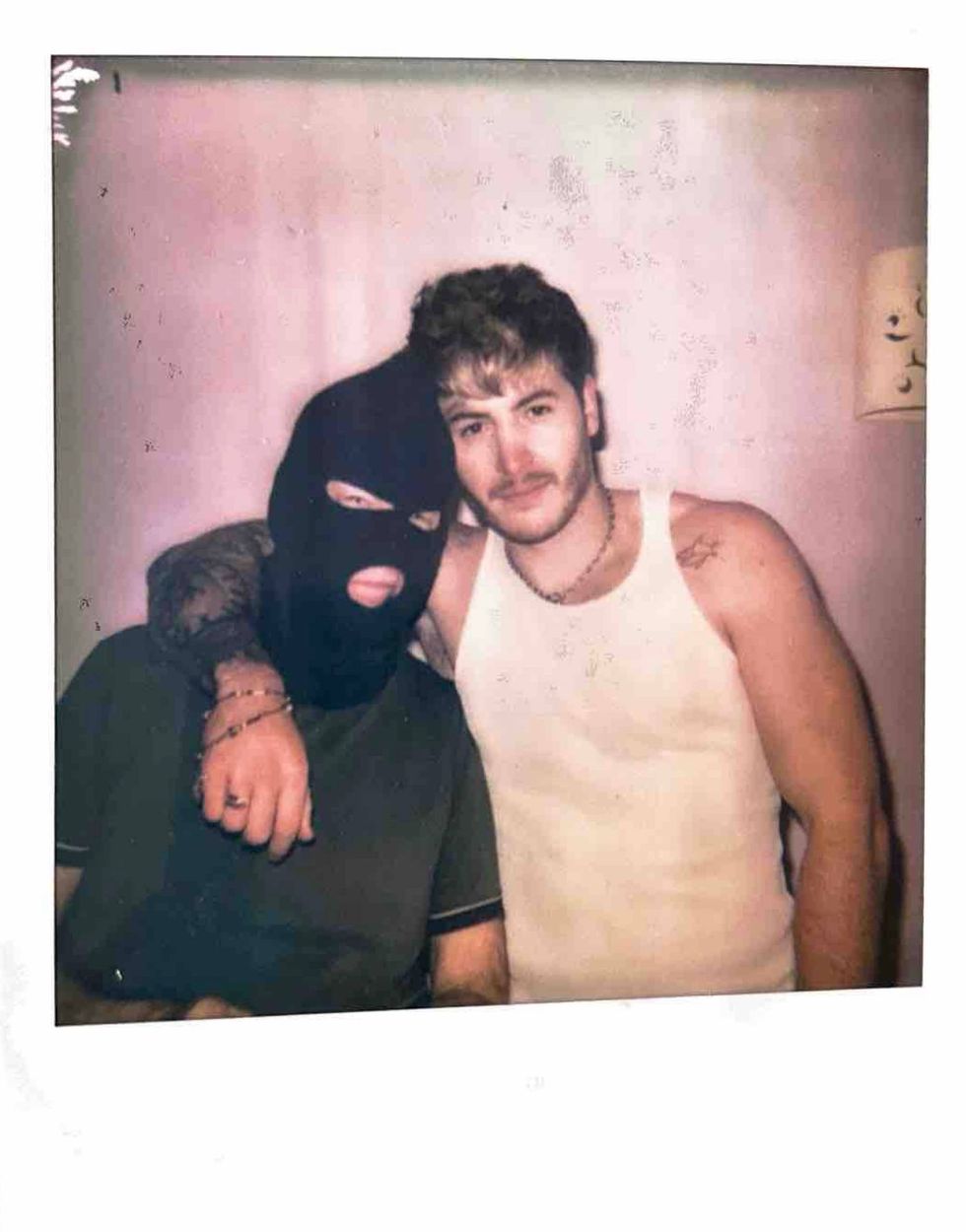
Speaking of the producers, could you talk to me about assembling that team? It’s clearly a very scrappy type of production.
My producers on the film, Will [Youmans], Waylon [Sall], Bijan [Kazerooni], and Adam [Kersh]…those are my boys. Could not have made the film without them. Will I went to college with; he produced a film called Shithouse in 2020. Adam is my manager now. We all have intensely close working relationships, we want to work with each other on a million things.
It was a very scrappy production, and it required so much know-how that we were learning as we went. We made this film for no money. We spent most of our money flying in actors and putting them up, and because I love Reed and Kieron, I really wanted it to be them.
Going through the process of making a feature is so consuming. There is something to do like every second of the day for probably a month. It was almost unexpected — I’ve never directed a feature before. It was all work we were happy to do, but it was very scrappy.
How long was the shoot itself?
12 days. Well, it ended up being 12 and a half because we shot the climax on the last day. It was the last thing we shot, and there was this freak hard drive accident where the entire day's worth of footage got like corrupted and deleted, and we were like… [grimaces] And we had to call everyone back for half a day to recapture the magic of what Reed and Kieron had just poured their heart and soul into.
Where did you start with Reed and Kieron in the shoot to build that rapport and get them over the course of such a short time to a place where they're able to handle that scene?
We shot almost entirely chronologically, necessitated by Kieron’s body hair, which is waxed halfway through the movie. The first thing we did was the camboy opening, which immediately broke the seal on who Kieron thought Aaron could be. Whatever nerves either of our actors had were shattered pretty quickly.
I always remember production to be a pretty smooth experience, but our emotions definitely mirrored those of the film. It was a push and pull sometimes for us because we were just so in it. It was such a small crew, such an intimate experience.
Knowing that you started with the camboy scene, how did you and Kieron build out that Aaron persona?
At a certain point it becomes Kieron’s. We talked a lot about the book Nausea by Sartre, and that was kind of a guiding text. There are many content creators that we looked to for reference.
This is an archetype found everywhere in gay porn — this hyper-dominant findom camboy. So the first goal was familiarizing Kieron with the world that he was inhabiting, which he also took upon himself to do. We both really understood that it was a responsibility to do our due diligence and really try to get it right.
But at a certain point I'm not entirely in control of it anymore. Kieron or Reed are the instruments playing the notes.
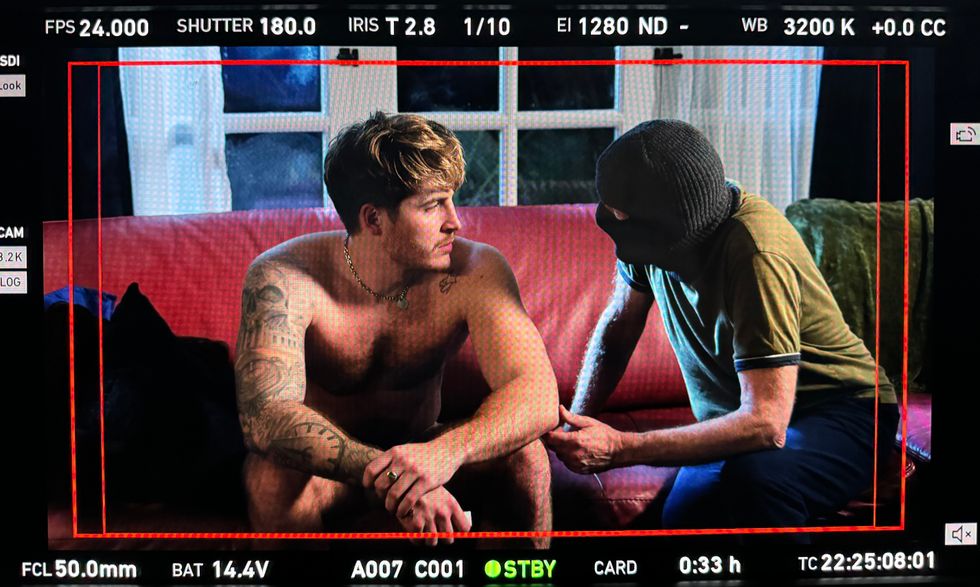
Have any of those creators seen the film?
This content creator named Tate Hoskins, who's a very, very sweet guy — incredible guy — came to see the film. We talked at length about it afterwards, and he really liked it. We’ve invited many content creators and sex workers to our special screening events, and I'm very excited to hear the reception.
Everything has been positive so far, which has been very humbling and nice to see.
Total pivot — how many times is the word “faggot” said in the film?
Oh my god, I don’t know!
For some reason, I was like, “he’ll have this stat ready.”
I can get a faggot count.
What’s your personal relationship with that word, in terms of putting it so heavily in the script? I feel like everyone has a journey with this word.
While I was writing, I was trying my best to just inhabit that character that you see in this kind of subsect of findom gay porn, and anything that came naturally to me as I was trying to inhabit this character in writing, I did.
My personal relationship with that word is not incredibly loaded. I'm sure it is for some people; in my circles, it has become kind of an affectionate term. For a lot of gay men it is a term that is either used affectionately or maybe they jerk off to sometimes. I think in a lot of ways that term has other connotations that are removed from prejudice, whether it's camaraderie or it's sexual.
I feel like it's like kind of a generational thing, which the film gestures at as well. Younger queers seem a lot more open to using it.
Yeah, kind of playfully. That is, I guess, the people that I'm around all the time. It's true, though! In the film, the word is just like a tool in a way. It's how Aaron can make money. It's a common fixture of his life as it is for many gay men's lives, you know?
What is it about the findom space that is so interesting and captivating to you creatively?
A lot of the film is sustained by this dissonance between a true self and an assumed identity, and rarely do I see that with as much clarity as I do in that section of gay porn. It's these people proclaiming that they are like the hottest guys you will ever meet. They're demanding money from you, lots of people are jerking off to it, and then at the same time these creators are recording from a dirty bathroom. It feels like a very extreme performance.
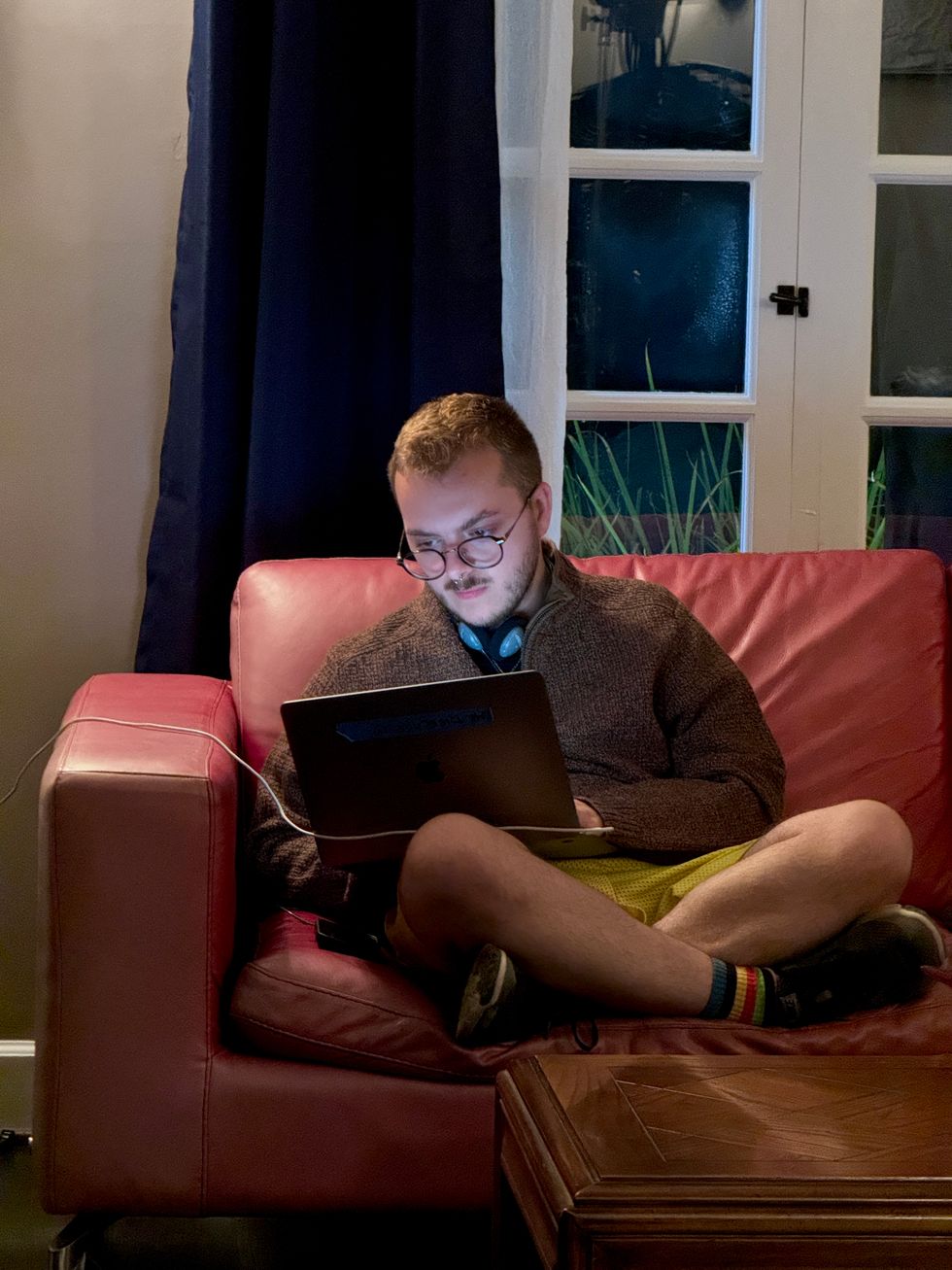
On the note of the dirty bathroom, could you talk me through the film’s various looks and especially the analog aesthetic?
I think there are four formats used in the film. We recorded straight from an old MacBook for the opening to the film. There are a couple of shots using the personal camcorder that Hank has. And then there's some stuff shot on MiniDV, and then some archival bits used as interstitials that were shot on a digital handheld from like the early 2000s. [Per the press notes, this interstitial footage is of a childhood Tuttle.]
I was really eager to create an aesthetic world that really balanced intimacy and danger. The camcorder aesthetic is a perfect example of that because at once it is used for family home movies and snuff films, and not a lot in between. I want the audience to feel really familiar and intimate with what's happening and still be kind of put on their back foot. And how do you represent that visually, not just in the dialogue? How do I maximize that impact? And so sometimes that is using Hank's personal camcorder, which has these intense, harsh red crazy colors, and we’re not gonna treat the color on that because that achieves this feeling. There was also lots of very deliberate and thorough planning with my DP, Ryan Jackson-Healy, who's so wonderful, and we looked at lots of color references, Bergman and Almodóvar and Aki Kaurismäki, who all use this really, really bold, emotionally expressive use of color. It was important to me, too, that the film not be afraid of color.
Something you mentioned in the Q&A, and I've seen you mention throughout your press — you describe the film a lot as being personal. Could you expand on that notion a bit?
Yeah, I think that a lot of the character of Aaron is informed by contemporary gay life. Even in this moment I'm feeling overwhelmed with where to start, because so much of what I've observed or felt as a gay man living in a major city is in that character. It’s in these feelings of fleeting, almost selfish love. The character of Aaron is someone who believes himself to kind of be wrong and broken, not even necessarily related to his sexuality, more the way that he exists in the world. And I think that there is something almost unique to at least gay men in the major metropolitan areas where I've lived that connections are kind of fleeting and tenuous. There is a really pervasive feeling of loneliness and inadequacy that a lot of us feel but don't often speak about. In that way, it feels very personal to me 'cause it's like a culmination of years as living as an adult gay man.
Maine is where Aaron grew up, but it’s where you grew up as well, correct?
Yeah, I grew up in Maine.
I don't know a ton about Maine. In that weird aughts/2010s upheaval moment with queerness, what was the overall prevailing culture there?
In Maine? I don't know if there was one to speak to. I had a really kind of wonderful coming out experience. A lot of my best friends at the time were soccer player boys, and they were the first people I came out to. We all went to go see movies together. I feel like I had a very kind of unique experience of going to a public school in a rural area that was very positive. But I don't know if I can even speak much to a culture because having Grindr at that time…the people you were meeting up with were all probably older. No one was completely out. I think that a scene has, from what I see, one has popped up now. Now there are drag shows at the local bars, which would have never happened when I was living there. Obviously, there is a queer culture anywhere that there are queer people, but it was very sequestered and disparate.
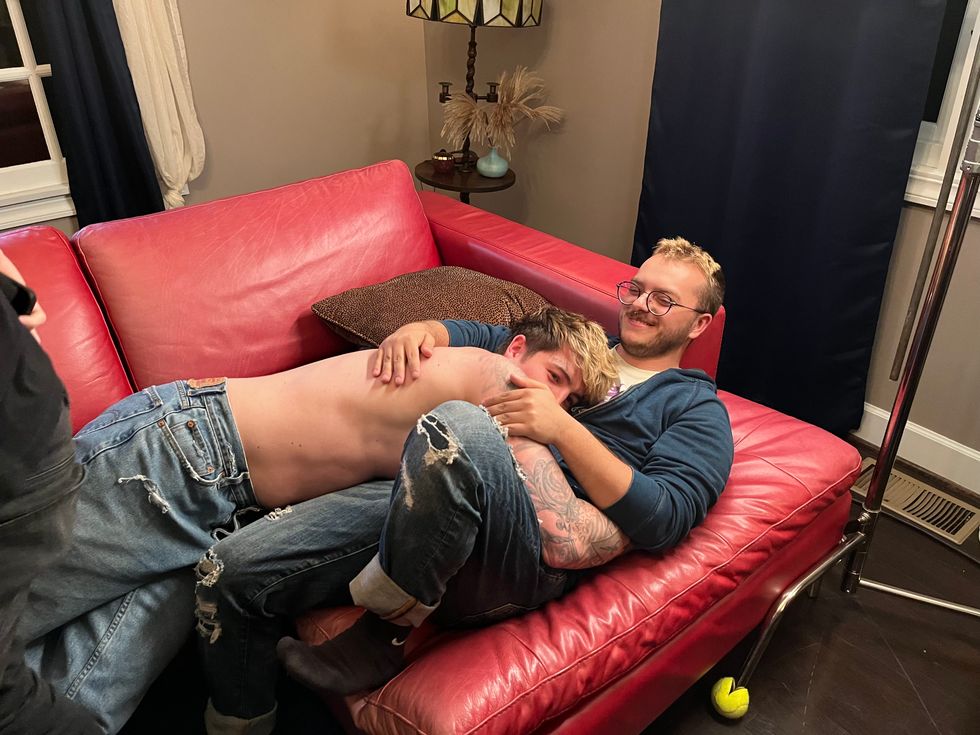
You mentioned in the Q&A that the film is informed to some degree by your own experiences with adolescent fantasy toward teachers.
I think it is more so reflecting on the fantasies I had at the time and thinking about a natural kind of extrapolation, like, "What was I actually fantasizing about that I didn't realize at the time?"
There are many all-consuming infatuations I had with teachers, and I think that that is probably common amongst many gay men. At the time, you — at least I can speak for myself — kind of have these infatuations, completely removed of any greater life context. I think I genuinely felt at the time like, "I wish this teacher would kiss me," or something. And I'm so glad that, you know, didn't happen. But the project came from thinking really honestly about that adolescent sexuality, how I experienced it as an adolescent, and then thinking about it with an adult perspective.
Catherine Breillat, who I've mentioned a lot in my press, really laid the blueprint for the way that people can make really vulnerable, honest work about taboo sexuality or adolescent sexuality. She and her ethos of filmmaking have been a place that I've looked to for inspiration for so long that this line of questioning about my own adolescent sexuality felt very natural.
With the title being Blue Film and the merch matchbooks, there’s clearly a degree of you enjoying the provocation. But the film is not, by any means, exploitative or overly salacious, treating everything with the thematic weight it deserves. How did you find that you squared those two impulses?
The former, with the matchbooks and such, is somewhat of a descriptor or a label that none of our filmmaking team put on themselves at all during the process of this film. To have that narrative then be created and embraced by the press is kind of a funny experience. The subject matter and the dialogue about the subject matter is, I guess, the scandalizing bit of the film. But there’s not really even any terribly explicit sex in the film. It’s interesting to see that people are more wary of the words than the sex.
It’s kind of been playful to lean into that, but the film that we made and intended to make is a drama through and through, trying to be as sensitive but also as honest as possible, so that is kind of still our guiding ethos.
To finish where we began, with Lana, Hank paraphrases “The Grants” in the film. Talk me through that decision, and in your mind, is this something that his pastor actually told him, or is he quoting Lana?
In my mind, it is something that his pastor actually told him, but it was also me paying homage to one of our greatest chroniclers of American sexuality. It’s funny to see who notices, and it’s nice because it brings other Lana fans to me.
In the world of the film, I thought it fit. I really love it as a quote of Hank's pastor. But yeah, it’s a little kind of moment or wink to an artist that I think shares a similar space.
And Hank is a Grant, after all.
That, but I also grew up on a street called Grant Street. So it made sense because I was thinking of Lana and that song, but also when you’re thinking of names it’s always like ‘[blank] street you grew up on.’
BLUE FILM is in theaters in Los Angeles and New York.
Photography is courtesy of Obscured Releasing.