G7’s $64 billion critical minerals push opens new opportunities for Africa as rare earth processing plant takes shape in West Africa
Despite the absence of major African economies such as Nigeria and South Africa from the G7 summit, the bloc’s $64 billion critical minerals push could still open fresh opportunities for the continent, as Kenya moves closer to a local processing agreement, while a rare earth processing plant takes shape in West Africa outside direct G7 financing.
 Black News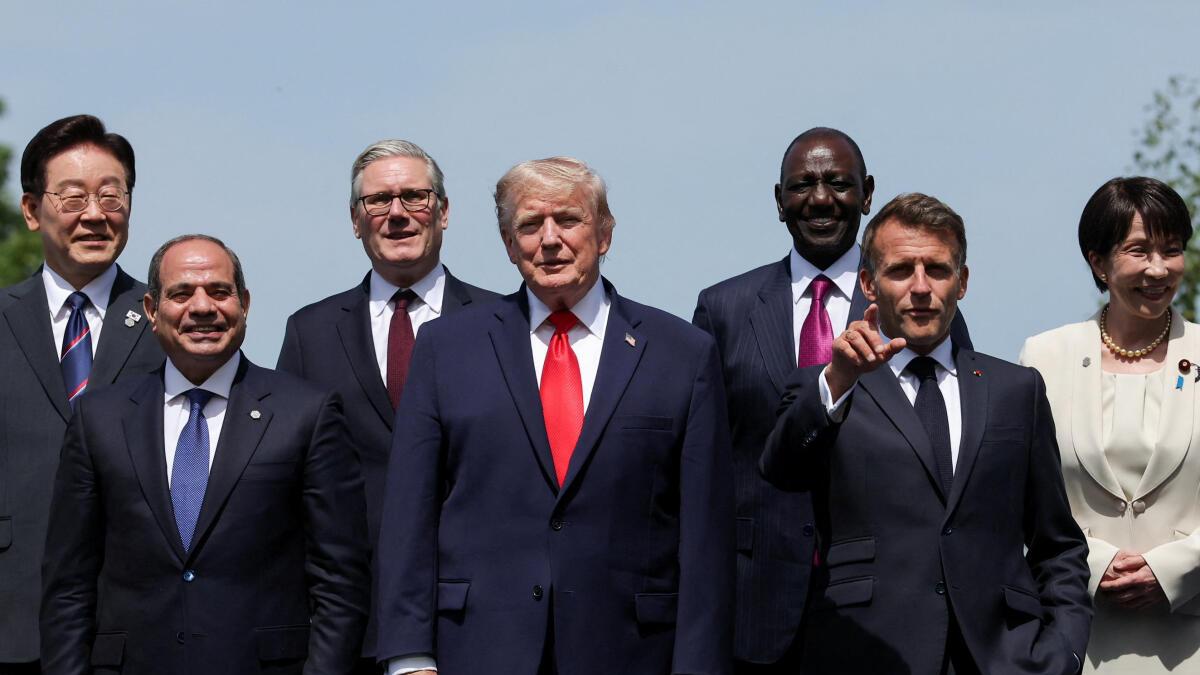

Despite the absence of major African economies such as Nigeria and South Africa from the G7 summit, the bloc’s $64 billion critical minerals push could still open fresh opportunities for the continent, as Kenya moves closer to a local processing agreement, while a rare earth processing plant takes shape in West Africa outside direct G7 financing.
- The G7 has formed a new critical minerals alliance to empower African producers and diversify global supply chains away from reliance on China.
- Kenya is pushing for a minerals deal with the US to ensure local processing, reflecting a broader trend in Africa for in-country beneficiation.
- Nigeria and the Democratic Republic of Congo are advancing major rare earth and cobalt projects, aiming to increase their roles in global supply chains.
- Financing and access to capital remain key challenges, with African leaders calling for risk-sharing mechanisms and better frameworks to leverage local resources for industrialisation and job creation.
G7 leaders meeting in Evian, France, on June 17, 2026, agreed to coordinate investment, processing, stockpiling, recycling and supply-chain data for critical minerals, including rare earths, lithium and nickel.
In their declaration, the leaders committed “to coordinating efforts within the G7 and with partner countries to establish and develop the necessary processing and industrial capacities for diversification of our critical minerals value chains.”
Africa Seeks More Value
For African governments, the pact comes as pressure grows to retain more value from mineral resources rather than export them for processing elsewhere.
The continent holds large deposits of cobalt, copper, lithium, graphite, manganese, rare earths and other strategic minerals, but refining and manufacturing remain largely outside Africa.
The agreement could support mineral-rich economies such as the Democratic Republic of Congo, Zambia, Kenya, Nigeria, Zimbabwe and Namibia, if it attracts investment in processing, power, transport and industrial capacity, like China’s model of building mineral value chains.
South Africa remains relevant
Although South Africa, the continent’s largest economy, was not represented at the summit, its absence stood out because President Cyril Ramaphosa had earlier been expected to attend.
France said Kenya had been invited instead and denied reports that South Africa was excluded under pressure from Washington.
Nonetheless, South Africa remains important to the critical minerals sector because of its reserves of manganese, platinum group metals, rare earths and other minerals used in clean-energy and industrial supply chains.
It also has one of Africa’s most developed industrial bases, giving it processing and infrastructure capacity that could support the continent’s role in the value chain.
Kenya pushes local processing
During the meeting, President William Ruto said Kenya was close to sealing a critical minerals deal with the United States covering rare earths and other strategic minerals.
The proposed agreement would allow Kenya to process the minerals locally instead of exporting them as raw materials.
“We have agreed that the minerals will be processed in Kenya,” Ruto said after talks at the G7 summit.
“We’ve agreed with them on what is mutually beneficial between Kenya and the United States, and President Trump and the American administration are happy with it.”
Kenya’s position reflects a wider African shift. Governments are increasingly demanding local processing, better offtake terms and more value retention from mining deals.
“These natural resources can no longer be exported and processed elsewhere. They have to be processed in-country and in-continent. We have to create value out of them,” Ruto said.
Despite Kenya’s close economic relationship with China, Ruto used the G7 platform to argue for broader partnerships with the West.
He said Africa was not choosing one bloc over another, but seeking deals that support industrialisation and jobs.
“There are opportunities for everybody,” he said.
Nigeria’s rare earth ambitions
Nigeria’s push into rare earth processing also fits into the wider African effort to build local capacity in critical minerals supply chains.
A Nigerian government delegation recently inspected the site of a planned $400 million rare earth processing facility in the country’s North Central region.
The project, being developed by an indigenous mining company, is expected to add 12,000 tonnes of annual processing capacity to its existing operations, raising total output to 18,000 tonnes a year.
The project has been in transition since June 2025, with further confirmation coming from the state governor in November and renewed attention after the government delegation’s visit in June 2026.
“For the first time in Nigeria, we are going to have the rare earth critical metal processing plant that includes: platinum, uranium, chromium, and so many other metals that are coming into our state,” the governor said in a statement.
DRC and mineral records
The Democratic Republic of Congo remains central to the critical minerals race because of its cobalt reserves, which are vital for battery supply chains.
It is also seeking access to colonial-era geological records held in Belgium to help map underexplored mineral deposits.
U.S. mining company KoBold Metals has been linked to efforts to digitise the records and support Kinshasa’s search for new critical minerals.
Egypt’s diplomatic role
Egypt also used the G7 summit to strengthen its role in wider supply-chain discussions.
President Abdel Fattah el-Sisi attended as one of the invited leaders, making Egypt the only North African country represented at the meeting.
His presence gave Cairo a platform to deepen ties with Western powers while maintaining its long-standing economic relationship with China.
Egypt’s strategic location, industrial base, ports and access to the Suez Canal make it relevant to global supply-chain planning, even though other African countries hold larger mineral reserves.
Financing remains the test
Financing remains the main test for Africa’s critical minerals ambitions.
The G7 said 195 critical minerals projects announced since the start of 2026 had reached €64 billion in investment, including equity participation and offtake agreements.
It also said development finance institutions and export credit agencies would coordinate more closely on critical minerals and related infrastructure.
Ruto told G7 leaders that Africa’s challenge was not lack of capital, but barriers to accessing it.
“We are not short of capital … what we need is a framework to mobilise it,” he said.
He called for guarantees and risk-sharing mechanisms to unlock African pension funds, insurance assets and reserves.
“Africa is not a problem to be solved,” Ruto said. “It is an opportunity that can be harnessed for global progress.”