Germany, South Africa push diplomacy as US–Iran ceasefire hangs in balance
Germany and South Africa have jointly called for renewed negotiations between the United States and Iran, warning that the collapse of talks in Pakistan threatens a fragile ceasefire that is critical to global stability.
 Black News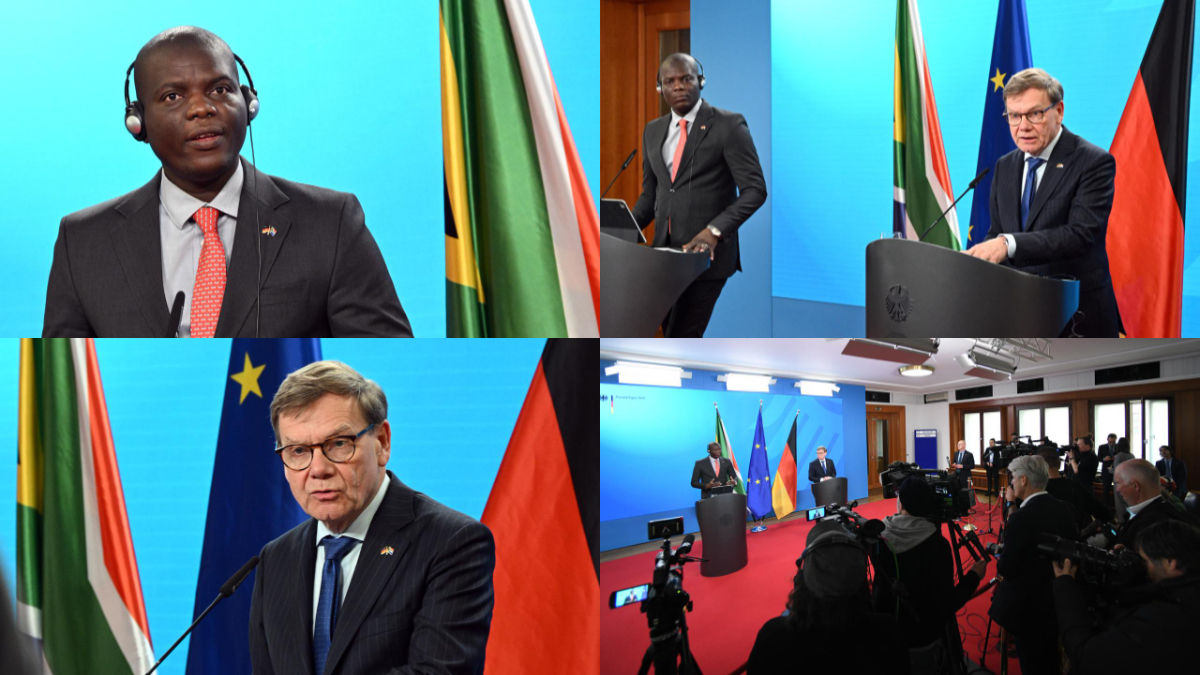
![German and South African foreign ministers meet in Berlin to strengthen diplomatic and economic ties while urging renewed US–Iran negotiations amid global tensions. [Photo by @UbuntuRadioZA/X, formerly Twitter]](https://ocdn.eu/pulscms/MDA_/453c5fc1a52d632cda7bf2fff6876f1b.jpg)
Germany and South Africa have jointly called for renewed negotiations between the United States and Iran, warning that the collapse of talks in Pakistan threatens a fragile ceasefire that is critical to global stability.
- Germany and South Africa have called for renewed US–Iran negotiations after talks collapsed in Pakistan, warning of risks to global stability.
- Both countries stressed the importance of maintaining the fragile ceasefire agreed on 6 April 2026.
- The Berlin meeting also produced a strategic partnership covering energy transition, technology, and climate finance.
- Key funding and cooperation initiatives aim to deepen ties between Europe’s largest economy and Africa’s most industrialised nation.
Speaking in Berlin on Monday, April 13, 2026, during the 12th session of the German-South African Bi-National Commission, Foreign Ministers Johann Wadephul and Ronald Lamola emphasised the urgency of sustained diplomacy following the 6 April truce between Washington and Tehran.
“We believe it to be of the utmost importance that negotiations continue… The ceasefire is holding,” Wadephul said, urging both sides to “make use of this time” in the interest of the international community.
The two-week ceasefire was agreed in an eleventh-hour effort to avert escalation, after US President Donald Trump warned of catastrophic consequences if hostilities intensified.
Lamola reiterated Pretoria’s long-standing position against military escalation, criticising both the US-Israeli strikes on Iran and Tehran’s retaliatory attacks across the Gulf. He described the breakdown of negotiations as a missed opportunity for a near-term resolution.
“As South Africa, we believe in diplomacy… if negotiations are at an advanced stage… there was no need for the strike,” Lamola said, while also condemning Iran’s counterattacks as violations of international law.
Beyond geopolitics, the Berlin meeting underscored growing economic alignment between Europe’s largest economy and Africa’s most industrialised nation. The two countries signed a 15-point plan to elevate ties to a strategic partnership, with a strong focus on the energy transition and technology.
![German and South African foreign ministers meet in Berlin to strengthen diplomatic and economic ties while urging renewed US–Iran negotiations amid global tensions. [Photo by @UbuntuRadioZA/X, formerly Twitter]](https://ocdn.eu/pulscms/MDA_/13b84537b2da535365b19cc0bf56610a.jpg)
As part of the agreement, Germany pledged €200 million, approximately $218 million using current conversion benchmarks, in concessional climate financing under the Just Energy Transition Partnership.
The funding will support South Africa’s power grid expansion and renewable energy investments, key to easing its chronic electricity shortages.
Berlin and Pretoria also expanded cooperation in artificial intelligence, quantum research, cybersecurity, and green industrialisation, including hydrogen production and battery value chains. The inclusion of vaccine manufacturing signals a continued shift towards resilient supply chains in emerging markets.
The meeting coincides with the 30th anniversary of the Bi-National Commission, established by Nelson Mandela and Helmut Kohl in the post-Cold War era. It also comes as South Africa marks over three decades since the end of apartheid, reinforcing its positioning as a diplomatic voice for the Global South.
For investors and policymakers alike, the dual message from Berlin is clear: geopolitical stability and green investment remain deeply intertwined, and both hinge on sustained international cooperation.