He’s Not ‘Down Low.’ He’s Down Bad — And We’re Missing The Point. [Op-Ed]
In this op-ed, Dominique Morgan explains why Dwight Howard's rumored sexuality is not the warning sign; his behavior is. The post He’s Not ‘Down Low.’ He’s Down Bad — And We’re Missing The Point. [Op-Ed] appeared first on MadameNoire.
 Black News
 ![He’s Not ‘Down Low.’ He’s Down Bad — And We’re Missing The Point. [Op-Ed]](https://madamenoire.com/wp-content/uploads/sites/9/2026/04/17769951853057.jpg?quality=80&strip=all&w=1024&crop=0,0,100,683px#)


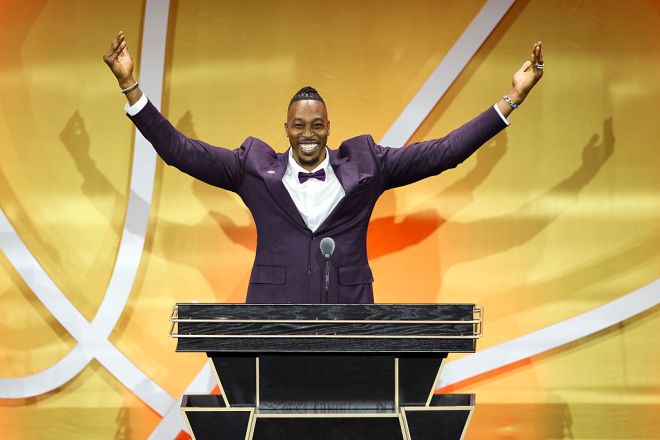
We have taught people to fear a type of man before we have taught them how to recognize a harmful one.
So when secrecy shows up, when betrayal shows up, when a man is exposed, when same-sex intimacy enters the story, many people reach for the same explanation: he must be down low. The label arrives fast. Faster than the facts. Faster than the pattern. Faster than the harder questions that might actually protect somebody.
I understand why.
RELATED CONTENT: When A Sistah Misses The Signs: Famous Women Who Married Down-Low Men And Didn’t Know It (And A Few Who Did)
Fear does not have to be perfectly reasoned to be real. Many Black communities learned to make meaning out of pain with whatever language was available: secrecy, cheating, shame, abandonment, disease panic, masculinity, betrayal, and public humiliation. Those are not abstract things. Those are lived things. So I am not interested in mocking what people fear.
I am interested in asking whether the framework we have been given is actually helping us survive.
Because the label is not the warning sign.
A man being private is not the same thing as a man being deceptive. A man being queer is not the same thing as a man being exploitative. A man being closeted is not the same thing as a man being abusive. And yet public conversation keeps collapsing all of those possibilities into one category, as if hidden sexuality explains every form of relational harm.
It does not.
What harms people is not always who a man desires. Often it is how he moves. The lying. The split realities. The image management. The entitlement. The way he uses one person for comfort, another for status, another for sex, another for labor, another for silence. The way accountability seems to humiliate him more than wrongdoing does. The way exposure turns him cruel. The way the same confusion follows him from room to room, partner to partner, context to context, while the public still treats him like a mystery instead of a pattern.
That is why Dwight Howard is such a revealing public case. Howard was one of the defining stars of his era, an eight-time All-Star who led Orlando to the 2009 NBA Finals and won three straight Defensive Player of the Year awards. Greatness that visible often becomes a shield. People read talent as character. They read charisma as goodness. They read institutional validation as proof that whatever damage surrounds a man cannot really be that serious.
The post He’s Not ‘Down Low.’ He’s Down Bad — And We’re Missing The Point. [Op-Ed] appeared first on MadameNoire.