My College Tour Calculation
It was a rainy afternoon at a small college in upstate New York. Prospective students and families had listened all The post My College Tour Calculation appeared first on Moment Magazine.
 Black News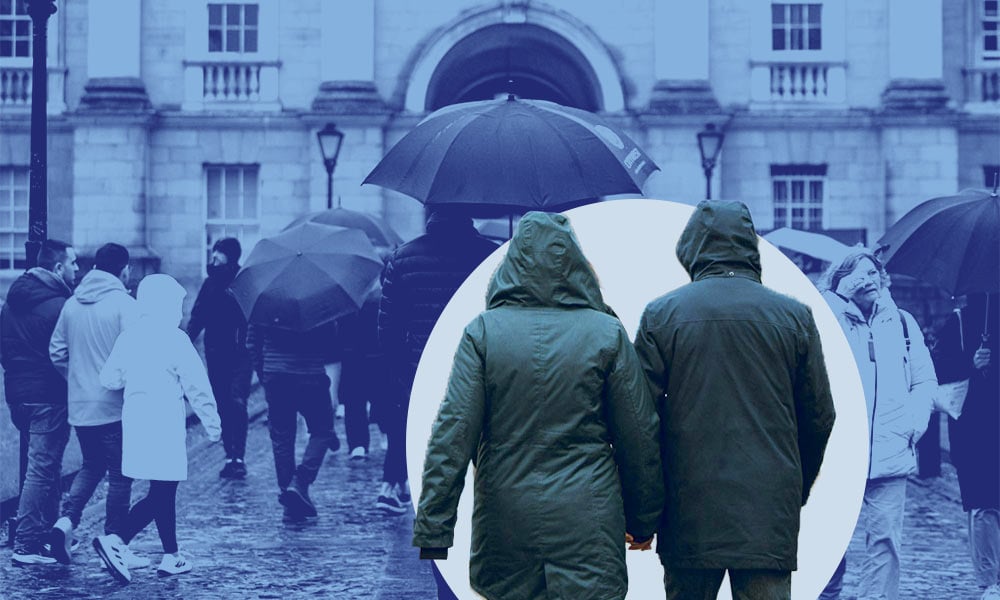
It was a rainy afternoon at a small college in upstate New York. Prospective students and families had listened all morning to the campus-wide commitment to personal attention and student-centered experience as expressed by administrators. And now, as proof, student tour guides would escort individual families, rather than herding larger groups. We would have their full, undivided attention.
I had a question about Jewish life I planned to ask since we left our house. But when I watched other families peel off, it became apparent that we’d be paired with a student guide wearing a keffiyeh. She wore it confidently, with a tweed jacket, slim-fitting jeans and impeccable makeup. To my surprise, I started to panic—not because I assumed anything about her, or doubted that we would have a warm conversation. I could not quell the anxiety that she might somehow read us, place us, know we were Jewish before we chose to say it ourselves.
I wasn’t proud of the calculation. But I couldn’t ignore it either. It felt less like noticing an accessory and more like trying to read a new language: one where clothing, slogans and affiliations can signal not just politics, but belonging and alliance.
On another campus, we passed a sprawling encampment lashed by a storm: tents sagging, posters smeared. There was one occupant, stubbornly ignoring the rain. I remember wanting to pull my son under my poncho and cross this place off our list. The feeling stayed with me afterward. Did I really want to write off one of the world’s best schools?
Over the past few years, the national conversation about campus antisemitism has largely centered on students and administrators: protests, policies, statements and hearings. Recent incidents have only intensified that focus. At the University of Michigan, a professor’s commencement speech praising pro-Palestinian student activists drew immediate backlash and a formal apology from university leadership, underscoring how even ceremonial spaces are now politically charged. Rutgers University cancelled its graduation speaker after students protested his criticism of Israel on social media. And at Cornell, tensions after an Israel-Palestine debate escalated to direct confrontation between the university’s president Michael Kotlikoff and student protesters, in which he backed into them with his car. These incidents capture just how fraught, even explosive, these interactions have become.
At first, watching the Cornell video, I was horrified. Why would humble students harass a college president? And why didn’t he wait to back out? When I was at Cornell, I practically bowed whenever Hunter Rawlings III walked by. I would certainly expect the same deference from my son. In my day, the only issue roiling the campus was who had placed a pumpkin on the clock tower. Maybe our children are being asked to navigate a world that demands a different kind of conviction, or a different sense of boundary. Or maybe they are simply learning, in real time, where the lines begin to blur. We are all trying to find our footing in that shifting space, balancing comfort and courage without a clear map.
These moments dominate headlines. But there is a quieter constituency moving through this landscape with its own set of questions. Parents, walking campuses with their children, trying to imagine not just where they will learn, but where they will feel at ease. Where can they explore different versions of themselves, while also being—well, themselves.
In private, and increasingly in public, those parents are finding one another. Swelling numbers of online communities—most notably Mothers Against Campus Antisemitism—have become clearinghouses for everything from firsthand accounts and screenshots to advice, outrage and organizing. They are messy, emotional, sometimes controversial spaces. They are also, unmistakably, a sign that something has shifted: Families are no longer passive observers of campus climate, but active participants in interpreting and responding to it.
For me, that shift has played out not only online, but closer to home. At my own university workplace, even a playful “favorite campus coffee” poll devolved into a spat on a whiteboard about boycotting Starbucks to free Palestine. I’ve attended events related to Israel that were interrupted or shut down by shouted accusations, phones held aloft as everyone recorded. Eighteen months ago, “Wanted” posters targeting Jewish faculty and staff appeared in campus tunnels—spaces I still find myself avoiding, even on the most frigid days.
Individually, each of these moments can be explained, contextualized, debated. Together, they form a backdrop that is increasingly hard to ignore, especially for parents searching for their child’s four-year home.
Universities have long positioned themselves as laboratories for difficult, even uncomfortable ideas. But what one student experiences as political expression, another experiences as exclusion—or worse. Administrators invoke the language of open inquiry; students invoke the language of safety and belonging. And parents, standing just outside that frame, are left trying to interpret not only what is being said on campus, but how it is being received. The result is not a simple clash of opinions but something more disorienting: Competing narratives of justice, each deeply felt, each rooted in real experience, and not easily reconciled.


I recently rewatched an episode of Beverly Hills, 90210 in 1994, in which a controversial campus speaker at the fictional California University pitted the Black Student Union against the Maccabee Center. Each side digs in their heels, with Brandon Walsh (Jason Priestley) desperately trying to stay neutral. (He suggests the BSU invite someone less problematic…like Bill Cosby.) Rallying for the Maccabee Center, Andrea Zuckerman (Gabrielle Carteris) has sharp words for both her friends and her husband, who reminds her that she is “not a very tolerant person” when it comes to other points of view. Before the protest, which has drawn local media coverage, Andrea apologizes to her grandmother Rose (Bess Meisler), a Holocaust survivor, for the “horrible memories” this has stirred. Rose replies: “Andrea: there will always be ignorance and swastikas, and hate crimes, and worse. But for me tonight, what is distressing is that you have been fighting with your friends, and have distanced from your husband…There’s also a time to listen, a time to turn the other cheek.”
I was touched. That’s the kind of advice I would share with my child: Shalom bayit at its finest. But it’s advice that MACA would probably hate. And aren’t I a mother against campus antisemitism?
During that drizzly afternoon with the keffiyeh-clad tour guide, we passed the Center for Jewish Life without comment. I could have easily pointed it out. After all, she had mentioned the vibrant diversity on campus and the joys of learning from others. But I held my breath and quickened my pace. Nothing in her words or demeanor suggested I needed to hold back. And yet I did. We moved on to safer topics like the best smoothies and the shuttle to Manhattan.
We had a lovely tour, but I kept returning to the question about Jewish community on campus that I failed to ask. The identity I chose not to name. The calculations burrowing through my mind beneath the polite chatter.
We tell our children to speak up, to engage and to show courage in the face of discomfort. Are we asking more of them than we are of us?
The post My College Tour Calculation appeared first on Moment Magazine.