Omar Rayo’s ‘Labyrinth’ Reframes Modern Latin American Art
At first glance, Omar Rayo’s paintings appear to belong to the orderly universe of geometry. Crisp black-and-white planes fold into one another with astonishing precision, ribbons weave endlessly through impossible spaces, and flat surfaces suddenly acquire the illusion of depth. For decades, these hypnotic compositions have earned the Colombian artist comparisons with the international Op […]
 Black News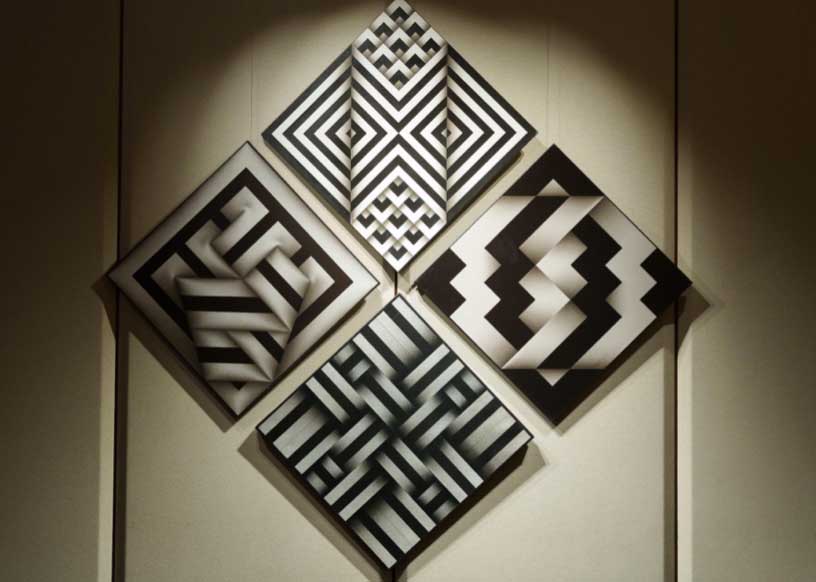
At first glance, Omar Rayo’s paintings appear to belong to the orderly universe of geometry. Crisp black-and-white planes fold into one another with astonishing precision, ribbons weave endlessly through impossible spaces, and flat surfaces suddenly acquire the illusion of depth. For decades, these hypnotic compositions have earned the Colombian artist comparisons with the international Op Art movement. Yet a new exhibition in Bogotá argues that such a reading tells only part of the story.
Omar Rayo: The Study of the Labyrinth, presented by the Leon Tovar Gallery is both a tribute to the artist’s celebrated works of the 1960s and 1970s and an invitation to reconsider his legacy. Rather than emphasizing optical illusion alone, the exhibition explores the intellectual and cultural foundations that shaped Rayo’s distinctive visual language, revealing an artist deeply engaged with the ancestral traditions of Latin America.
The appointme-only showing at the Gun Club in Bogotá presents a carefully curated selection of monochromatic paintings, inviting visitors to look beyond their immaculate surfaces and discover a body of work rooted in historical research, Indigenous knowledge and cultural memory.
While Rayo embraced many of the formal concerns that defined international modernism, his artistic vocabulary emerged from extensive travels throughout Latin America, where he studied the visual systems developed by pre-Columbian civilizations. Geometric incisions carved into ancient ceramics, the rhythmic structures of Andean textiles and the architectural reliefs of cultures including the Inca and Nazca became enduring sources of inspiration.
These influences never appeared as direct quotations. Instead, Rayo distilled them into a highly refined abstract language in which every line, shadow and intersection contributes to a carefully balanced composition. His paintings reject ornament in favor of disciplined geometry, transforming ancestral motifs into works that feel both timeless and unmistakably familiar.
Central to the exhibition is the idea of the labyrinth, a recurring concept that extends beyond visual complexity. For Rayo, the labyrinth was not a place of confusion or entrapment but a symbol of spiritual inquiry, continuity and belonging. His compositions invite prolonged contemplation, encouraging viewers to navigate intricate spatial relationships that gradually reveal unexpected harmony beneath their apparent complexity.
Perhaps most remarkable is the painstaking craftsmanship behind the works. Long before the advent of digital design software, every illusion of depth, every subtle transition between light and shadow, and every precisely calibrated edge was executed entirely by hand. The precision often suggests mechanical production, yet each painting bears the unmistakable evidence of extraordinary technical discipline and artistic patience.
Born in 1928 in the town of Roldanillo, in Colombia’s Valle del Cauca department, Rayo discovered drawing as a teenager after enrolling in a correspondence course offered by the Zaer Academy of Buenos Aires. He began exhibiting professionally in 1948, launching a career that would steadily gain international recognition.
Scholarships from the Organization of American States enabled him to live in Mexico between 1959 and 1960 before relocating to New York, where he remained until 1976. During those years, Rayo developed the visual language that would define his career while participating in an increasingly international dialogue about abstraction and modern art.
Although Fernando Botero became Colombia’s most recognizable artist among the general public, Rayo’s work is represented in more international museum and gallery collections than that of any other Colombian artist, underscoring the remarkable reach of his career. His paintings are held in the permanent collections of institutions including the Museum of Modern Art, the Metropolitan Museum of Art in New York and the Art Institute of Chicago, alongside hundreds of museums, universities and private collections across Europe, the Americas and Asia.
Even as his reputation grew abroad, Rayo maintained close ties to his birthplace. In Roldanillo (Valle del Cauca), he founded the Museo Rayo, creating one of Colombia’s most important centers dedicated to Latin American drawing and graphic arts. The museum continues to serve as a cultural landmark, bringing international exhibitions and visitors to a town better known for its sugarcane fields than its art scene.
By presenting Rayo’s geometric masterpieces within the broader context of Latin America’s artistic heritage, Omar Rayo: The Study of the Labyrinth encourages viewers to reconsider an artist often categorized too narrowly. His paintings demonstrate that abstraction can be more than an exploration of form. In Rayo’s hands, geometry became a bridge between ancient civilizations and contemporary art, revealing a visual language in which the memory of the Americas continues to unfold with quiet elegance and enduring relevance.
For audiences, the exhibition is more than a survey of optical precision. It is an opportunity to rediscover an artist whose work helped redefine modern abstraction by drawing upon the ancestral visual traditions of the Americas. More than half a century after these paintings were created, Rayo’s labyrinths continue to draw viewers inward, offering no easy exit—only new ways of seeing.
To book an appointment and inquiries contact: info@leontovargallery.com