SAHWANYA-FRODEBU Rejects Plan to Transfer Ndadaye’s Remains, Calls for National Consensus
As part of a broader heritage project, the government intends to relocate the remains of several national figures to a single memorial site, prompting backlash from the opposition.
 Black News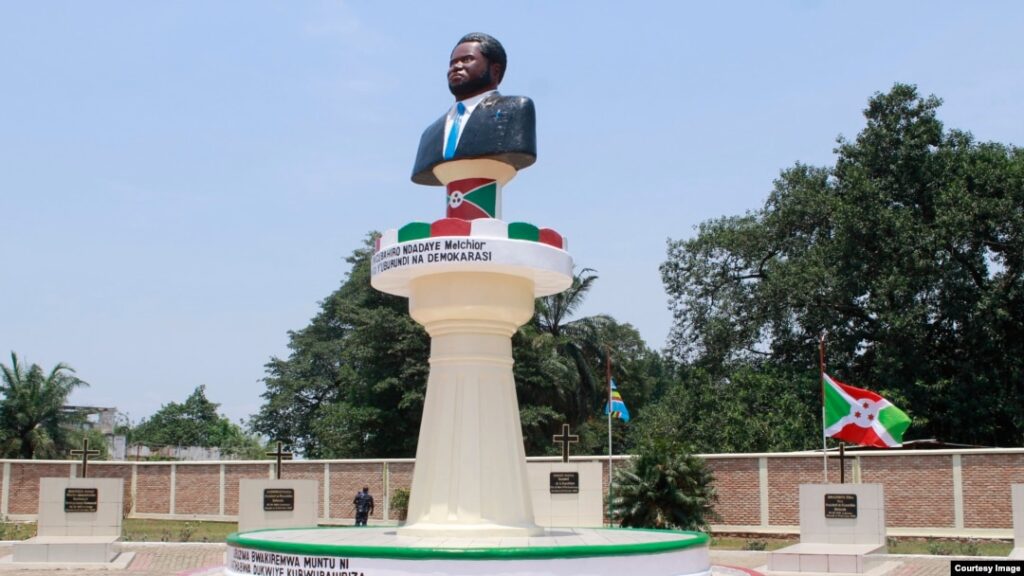
Opposition party SAHWANYA-FRODEBU has opposed a government proposal to exhume and relocate the remains of Burundi’s first democratically elected president, Melchior Ndadaye, to a memorial site where independence hero Prince Louis Rwagasore is buried.
In a statement posted on X on Monday, the party founded by Ndadaye criticized the government’s decision, saying it had been taken without consulting key stakeholders.
“The move was made without consultation with the party, the families concerned, and democratic forces,” the statement said. “The memory of the martyrs of democracy requires dialogue and national consensus.”
The controversy follows remarks made by Finance Minister Alain Ndikumana while presenting the government’s major projects under the 2026–2027 national budget during a recent session in the National Assembly.
Ndikumana announced that the government was considering transferring the remains of Ndadaye and other national figures buried at the Ndadaye Memorial Site in Bujumbura to the Ubumwe Memorial Site in Kiriri, where Prince Louis Rwagasore is laid to rest.
“The body of Melchior Ndadaye, together with those of other national heroes buried alongside him at the Ndadaye Memorial Site in Bujumbura, will be exhumed and reburied at Ubumwe, where the remains of Prince Rwagasore are buried,” Ndikumana told lawmakers.
Two National Heroes
Burundi officially recognizes two national heroes: Prince Louis Rwagasore, regarded as the hero of independence, and Melchior Ndadaye, celebrated as the hero of democracy.
Rwagasore, Burundi’s first prime minister and a leading figure in the country’s struggle for independence, was assassinated on October 13, 1961, just months before Burundi gained independence in 1962. He was buried at the Ubumwe Memorial Site in Bujumbura, where annual commemorations are held in his honor.
Ndadaye became Burundi’s first democratically elected president in June 1993. His presidency was cut short when he was assassinated during a failed coup attempt on October 21, 1993, only three months after taking office. His death triggered widespread violence and massacres across the country.
Several cabinet ministers and senior government officials who were killed alongside him were buried at the Ndadaye Memorial Site near his former residence in Bujumbura. Since 2006, Burundi has commemorated Ndadaye’s contribution to democracy each year.
The site also contains the graves of Ndadaye’s successor, President Cyprien Ntaryamira, and other senior officials who died in the April 6, 1994 plane crash in Rwanda that also killed then-Rwandan President Juvénal Habyarimana.
Government’s Vision
Defending the project, Ndikumana said the government plans to allocate one billion Burundian francs to renovate the Ubumwe site and transform it into a unified “Memorial Site of Heroes.”
According to the minister, the current Ndadaye Memorial Site would be converted into a cultural center dedicated to preserving Burundi’s historical and cultural heritage.
The proposal has sparked debate among historians, political observers, and social media users.
Eric Ndayisaba, a historian and university lecturer, urged authorities to proceed cautiously, warning that the issue carries significant emotional and historical weight.
“The idea of exhuming the body of the hero of democracy deserves very careful consideration, both from a moral and anthropological perspective,” Ndayisaba wrote on social media on Monday.
“It is an extremely sensitive issue because the wounds still haven’t healed. Such an operation risks reawakening unnecessary trauma.”