A landmark ballot-access case: Dr. Butch Ware demands emergency federal order to restore his place on the ballot
"Voters have a right to choose between every candidate the Constitution makes eligible. The Secretary of State does not get to thin that field through arbitrary procedural traps." Dr. Butch Ware, Candidate for Governor The post A landmark ballot-access case: Dr. Butch Ware demands emergency federal order to restore his place on the ballot appeared first on San Francisco Bay View.
 Black News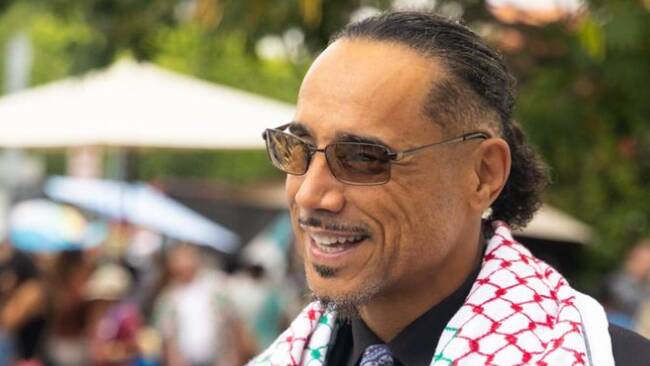
Sacramento, Calif. – The Butch Ware for Governor 2026 campaign has filed a federal civil-rights lawsuit and an emergency motion in the United States District Court for the Eastern District of California, demanding that Senior District Judge William B. Shubb issue a Temporary Restraining Order restoring Dr. Butch Ware to the gubernatorial primary ballot. Filed under 42 U.S.C. § 1983, the federal civil-rights statute, the case alleges that the California Secretary of State’s disqualification of Dr. Ware over alleged tax-return paperwork defects violated the First and 14th Amendments.
The lawsuit, captioned Ware v. Weber and assigned Case No. 2:26-cv-01643 WBS SCR, names California Secretary of State Shirley N. Weber as defendant in her official capacity. Lead counsel is James E. Tyrrell III of Dickinson Wright PLLC in Washington, D.C., joined by Eric R. McDonough of the firm’s San Diego office as local counsel.
The federal court is treating this as an emergency
Within 48 hours of the campaign’s filing, the Court issued a briefing order placing Ware v. Weber on an expedited emergency schedule. The Secretary of State’s opposition is due May 4, 2026, seven days after filing rather than the customary 21. The campaign’s reply is due May 6. The Court will then take the motion under submission and rule, with the earliest possible ruling date May 6 and the latest realistic date around May 12.
The schedule reflects a federal court moving as quickly as it can while still affording the State an opportunity to be heard. May 4 is also the day, under California Elections Code § 3001, that county election officials must begin mailing vote-by-mail ballots for the June 2 primary. The Court’s pace is the clock against the state’s own.
A landmark civil-rights case
The complaint advances three constitutional claims, all under 42 U.S.C. § 1983: First and 14th Amendment ballot-access violation under the Anderson-Burdick framework; 14th Amendment procedural due process; and 14th Amendment equal protection. The campaign argues that the Secretary of State’s office issued shifting and contradictory deficiency notices about Dr. Ware’s tax-return submissions over a 10-day window in March, culminating in a final notice at 4:50 p.m. on the March 16 statutory deadline that demanded cure by 5:00 p.m., a 10-minute window. Of the 61 candidates appearing on the gubernatorial primary ballot, several have tax submissions with the same alleged deficiencies the Secretary cited against Dr. Ware. They were not disqualified.
The campaign’s experience is itself the proof that California Elections Code §§ 8902 and 8903, the gubernatorial tax-return-disclosure law that Gov. Gavin Newsom signed into law in July 2019 as part of Senate Bill 27, cannot be administered fairly. The statute was unilateral in its drafting and selective in its application. What was sold as a principled disclosure rule has operated, in our case, as an administrative weapon used to thin the gubernatorial field.
A statute with a twin already struck down
This case is the first major federal challenge to the gubernatorial half of Senate Bill 27, the 2019 California statute requiring both presidential and gubernatorial primary candidates to disclose five years of federal tax returns as a condition of ballot access. The presidential half was struck down unanimously by the California Supreme Court in Patterson v. Padilla in November 2019, in litigation responding to a federal challenge originally brought by Donald J. Trump. The Court held, in language that speaks directly to this case:
“Ultimately, it is the voters who must decide whether the refusal of a [presidential primary candidate] to make such information available to the public will have consequences at the ballot box.” California Supreme Court, Patterson v. Padilla, 9 Cal.5th 1, 19 (2019)
The gubernatorial half, identical in design, has remained on the books, untested, for seven years. Ware v. Weber carries that same constitutional question into the federal courts. A ruling in Dr. Ware’s favor would complete the constitutional reckoning that Patterson began and would foreclose any future use of §§ 8902 and 8903 against gubernatorial candidates of any party.
“Voters have a right to choose between every candidate the Constitution makes eligible. The Secretary of State does not get to thin that field through arbitrary procedural traps. This case is about every Californian who believes ballot access should not depend on whether a candidate can navigate a 10-minute deadline.” Dr. Butch Ware, Candidate for Governor
About Butch Ware for California Governor 2026
Dr. Rudolph “Butch” Ware is running for Governor of California with the Green Party. He is a longtime organizer and movement builder, and is a tenured professor of African and Islamic history at University of California, Santa Barbara. He ran as the Vice Presidential candidate alongside Jill Stein in the 2024 U.S. Presidential election. His campaign is fully grassroots and does not accept corporate or super PAC donations. His platform includes guaranteed affordable housing, single payer healthcare, free community and state colleges for California residents, fully funded and expanded public transit, and more.
To learn more, go to his website, butchware4gov.org , Instagram: @butchware, Twitter: @ButchWare, Facebook: ButchWare4Gov2026
The post A landmark ballot-access case: Dr. Butch Ware demands emergency federal order to restore his place on the ballot appeared first on San Francisco Bay View.