GED Section: You Cannot Call It Freedom When One Group Can Tell Another How to Vote
Hughley argues that America's global defense of freedom rings hollow when Black voting rights face domestic restrictions, mirroring a pattern of Black sacrifice unmet by full citizenship.
 Black News
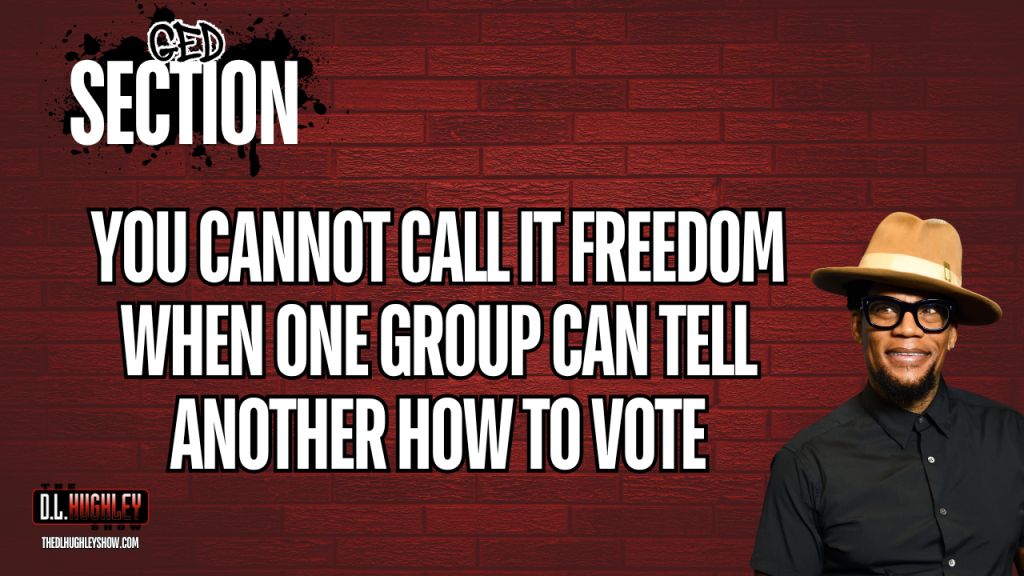
D.L. Hughley’s Notes from the GED Section drew a sharp line between America’s rhetoric abroad and its record at home, arguing that calls to defend freedom overseas ring hollow when Black voting rights remain under pressure in the United States. Speaking in the segment, Hughley framed the issue as more than political hypocrisy. He presented it as a recurring American pattern: moments of national crisis often come with renewed demands for Black sacrifice, even as Black citizenship is challenged through voter restrictions, unequal treatment and the lasting force of structural racism.
Freedom Abroad, Restrictions at Home
Hughley opened with a blunt claim: “You cannot call it freedom when one group has the power to tell another group how to vote.” That line set the tone for the segment, which linked international conflict with domestic disenfranchisement. As the nation debates threats from abroad and rallies around ideals of democracy, Hughley argued that many states are still advancing policies that make ballot access harder, particularly for Black communities.
His point lands in a political climate where voting rules remain a flashpoint after recent election cycles. By pairing war talk with ballot access, Hughley underscored a central tension in American life: the country often presents itself as a global defender of liberty while struggling to protect full democratic participation at home.
TRENDING STORY: Supreme Court Officially Reinstates Texas’ Congressional Map
TRENDING STORY: Tennessee Republicans Pass Map Eliminating State’s Only Majority Black District
Black Service, Denied Citizenship
Hughley then turned to history, noting that Black Americans have “fought and died in every single conflict that this nation has had.” He cited a long arc of service, from World War I and World War II to Korea and Vietnam, to show that patriotism has never been in short supply in Black America. What has been lacking, he suggested, is equal treatment in return.
The argument carries weight because it taps into a well-documented truth: military service did not shield Black Americans from segregation, exclusion or second-class citizenship. Hughley’s message was clear. Black loyalty to the nation has been repeatedly proven, but that loyalty has too often been met with barriers rather than full belonging.
From Jim Crow to a New Iteration
Hughley described the present moment as a “new iteration” of an old reality. He pointed to Jim Crow-era injustice, including segregation in the armed forces, as evidence that America has long maintained parallel systems — one that celebrates freedom in principle and another that limits it in practice for Black people.
That historical framing is significant because it rejects the idea that current battles over rights are isolated disputes. Instead, Hughley positioned them as part of a longer struggle over power, access and race. In that reading, today’s fights over voting and representation are not departures from history but extensions of it.
Unity Demanded, Rights Still Under Assault
Hughley closed on irony. At times of war or instability, he said, Americans are asked to unite, absorb economic pain and support the national cause. Yet even in those moments, Black rights remain vulnerable. “Whenever America fights for her freedom,” he said, “it is ironic that black people have had to fight for theirs.”
That argument resonates because it speaks to a familiar frustration in Black political life: being called on to defend democracy while still being forced to demand it. Hughley’s commentary did not just revisit history. It challenged listeners to examine whether the nation’s language about freedom has finally caught up to its obligations at home.
READ MORE DL HUGHLEY STORIES:
- GED Section: You Cannot Call It Freedom When One Group Can Tell Another How to Vote
- The Top 5 Reasons Why Teachers are Incredible
- The Jazzy Report: Cannabis Use Warnings and Homeland Security Closures