Ghana railway upgrade gains $21.6m EU support
Ghana’s efforts to modernise its rail infrastructure have received a boost after the European Commission approved a €20m grant, equivalent to about $21.6m, to upgrade the signaling systems on the Tema Mpakadan line.
 Black News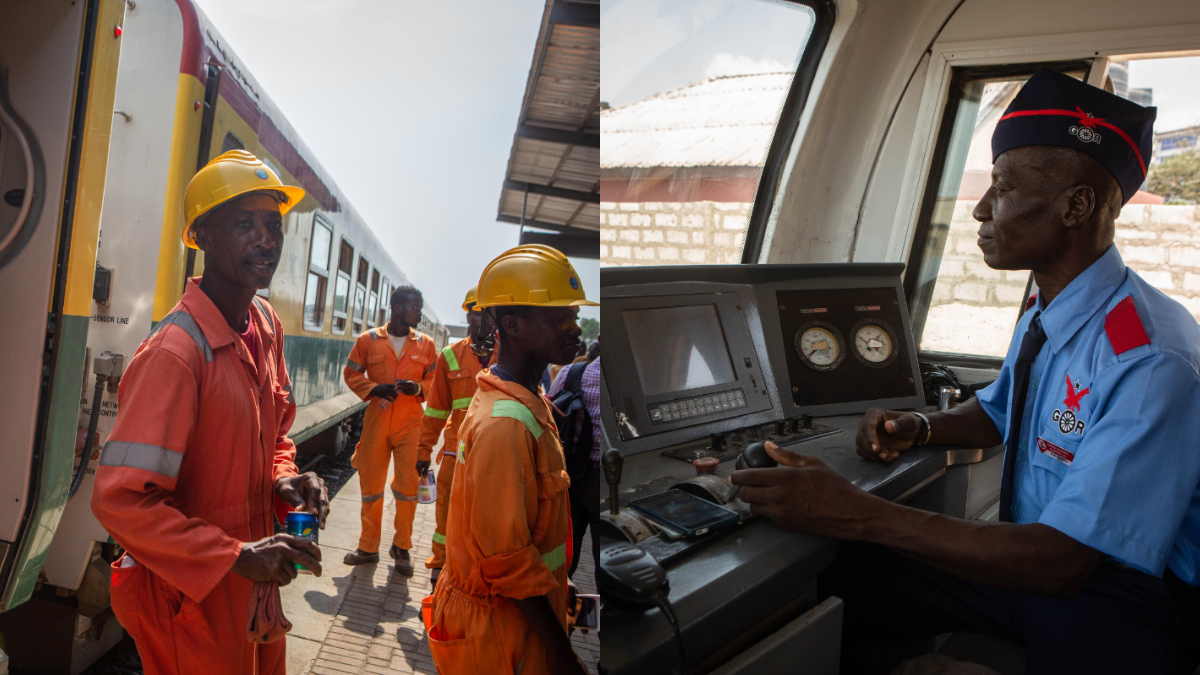
![Ghana’s Tema–Mpakadan railway line, where new EU-backed signalling upgrades aim to boost capacity, safety, and regional connectivity. [Photo credit should read RUTH MCDOWALL/AFP via Getty Images]](https://ocdn.eu/pulscms/MDA_/9e4e98cdf349a458036ec298ae5debd6.jpg)
Ghana’s efforts to modernise its rail infrastructure have received a boost after the European Commission approved a €20m grant, equivalent to about $21.6m, to upgrade the signaling systems on the Tema Mpakadan line.
- Ghana has secured a $21.6m EU grant to upgrade signalling on its Tema–Mpakadan rail line.
- The project aims to resolve operational limits that currently restrict train movement.
- Authorities say the upgrade will improve safety, efficiency, and infrastructure utilisation.
- The move reflects a broader shift towards grant-based financing amid fiscal constraints.
The funding will support the rollout of the European Train Control System Level 1, a move expected to significantly improve safety, capacity, and operational efficiency on the 97.6 kilometre corridor.
The line, which cost roughly $449m to construct and was commissioned in 2024, has struggled to operate at full capacity due to faulty signalling, restricting traffic to a single train at a time.
Dr. Frederick Appoh, Chief Executive of the Ghana Railway Development Authority, said the upgrade would transform the line’s performance.
“With ETCS Level 1 implementation, we will unlock safe multiple train operations, improve capacity and reliability, and ensure full utilisation of a strategic national asset,” he stated.
The Tema to Mpakadan route forms the first phase of Ghana’s planned 1,000-kilometre standard-gauge railway, designed to link the port city of Tema with inland regions and eventually extend to Burkina Faso.
Despite its strategic importance, the line has faced technical setbacks, including infrastructure faults and rolling stock reliability issues, prompting rehabilitation works ahead of a planned relaunch of passenger services in October 2025.
The latest funding underscores a broader shift in Ghana’s financing approach, as authorities increasingly prioritise grants over loans amid fiscal pressures. Appoh noted that the agreement highlights strong cooperation between Ghana and its European partners.
Disbursement of the funds is expected before the end of the year, potentially marking a turning point for one of West Africa’s most ambitious rail projects.