Rethinking South Sudan’s Unfinished Transition
South Sudan is approaching another decisive moment, but the country is still far from ready for credible elections in December 2026. Nearly two decades after the end of Sudan’s civil war (1983-2005) and almost fifteen years after independence, the promise of democratic transition remains unfulfilled. Whether South Sudan can still move toward peace and accountable government depends on confronting political realities that leaders have long avoided. The 2018 Revitalized Peace Agreement brought President Salva Kiir and First Vice President Riek Machar back into a unity government after years of civil war. The agreement reduced large-scale violence and created a framework […] The post Rethinking South Sudan’s Unfinished Transition appeared first on African Arguments.
 Black News
South Sudan is approaching another decisive moment, but the country is still far from ready for credible elections in December 2026. Nearly two decades after the end of Sudan’s civil war (1983-2005) and almost fifteen years after independence, the promise of democratic transition remains unfulfilled. Whether South Sudan can still move toward peace and accountable government depends on confronting political realities that leaders have long avoided.
The 2018 Revitalized Peace Agreement brought President Salva Kiir and First Vice President Riek Machar back into a unity government after years of civil war. The agreement reduced large-scale violence and created a framework for elections and constitutional reform. Yet many of its core provisions remain incomplete. The unification of armed forces has stalled, transitional justice mechanisms have not been fully implemented, and constitution-making has progressed slowly. In 2024, the transitional government again postponed elections, extending the transition period until December 2026.
The slow pace of reform has weakened public confidence in the peace process. Armed violence involving local militias and opposition groups continues in parts of Upper Nile, Jonglei, and Equatoria. At the same time, many South Sudanese citizens increasingly perceive the unity government as an arrangement that preserves elite power rather than one that delivers meaningful change.
A failed transition, not a failed state
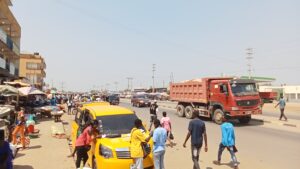
Street in Gudele, Juba
The roots of the crisis run deeper than delayed reforms or lack of political will. South Sudan still lacks the institutions and political consensus needed for a stable and inclusive state. The unity that accompanied independence in 2011 is now in trouble, in part because it was built largely on the basis of a shared struggle that united diverse communities against a common adversary, the Khartoum government. Once independence shifted attention toward governing the country, managing resources, and distributing power, those earlier bonds weakened. Political competition increasingly became tied to ethnicity, patronage, and control over state resources.
For this reason, South Sudan is better understood not simply as a failed state, but as a failed transition. The basic political premise of a state, a social contract, has yet to be forged. There is no meaningful consensus among political elites, nor between elites and citizens. Basic questions about citizenship, inclusion, the rule of law, and the distribution of power remain unresolved. Democratic principles such as accountability and justice are widely discussed but weakly protected in practice.
This is why elections alone are unlikely to solve the country’s political crisis. Under current political and technical conditions, credible elections in 2026 remain difficult to organize. More importantly, voting by itself cannot create legitimacy if the institutions overseeing the process lack public trust.
The shortcomings of the 2018 peace agreement reflect this broader structural problem. The agreement was designed primarily to stop violence through power-sharing among political elites. While that objective was understandable, the deal did not fully address the deeper causes of conflict or bring all armed actors into the process. Instead, it reinforced a political system in which access to state power remains the central prize.
The concentration of power in the presidency continues to undermine accountability. South Sudan’s transitional constitutional framework remains highly centralized and offers limited opportunities for meaningful public participation. This concentration of power encourages corruption, weakens institutions, and leaves many citizens disconnected from political decision-making.
The constitutional opening
Despite these limitations, the peace agreement still contains an important opening for change: the drafting of a permanent constitution stands out as a critical opportunity. If approached differently, constitution-making could become more than an elite negotiation process. It could help create a broader national conversation about the country’s future.
Progress, however, has remained limited. Although the government has formally begun parts of the constitution-making process, civil society organizations and opposition groups have expressed concern about weak public participation, political interference, and the government’s failure to provide the necessary funding. Without broader inclusion, the process risks reinforcing the very divisions it is supposed to address.
A more participatory constitution-making process could help South Sudan begin building a genuine political and social compact for the first time. Such a process would need to include women, displaced communities, minority groups, youth organizations, and local civil society actors rather than focusing narrowly on political elites in Juba. Public consultations and local dialogue forums could help citizens debate difficult questions about federalism, citizenship, minority protections, and balance of power between national and regional authorities.
This would not eliminate political tension overnight. But it could gradually shift politics away from ethnic mobilization and armed competition toward a culture of citizenship and democratic participation. A constitutional framework grounded in rights, inclusion, and accountability could also create strong incentives for political competition through civic institutions rather than military force.
Another important but often neglected part of the peace agreement is Chapter V, which calls for truth, reconciliation, and healing processes. South Sudan’s conflicts have left deep social and political wounds that cannot be addressed through elite bargains alone. A credible truth and reconciliation process could help communities confront past violence while also strengthening efforts to build national cohesion.
Still, constitution-making by itself will not guarantee democratic transition. Even the strongest constitutional framework requires political leaders willing to respect it. South Sudan also needs broader institutional reforms, including security-sector reform, stronger economic governance, and independent institutions capable of enforcing the rule of law.
What outside actors should do differently
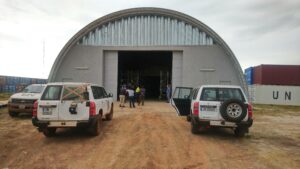
A UNMISS warehouse in Bentiu, South Sudan.
Regional and international actors will continue to play an important role, but outside engagement must move beyond short-term crisis management. Too often, external mediation has focused on maintaining elite political arrangements rather than supporting deeper democratic transformation. International partners should instead support a coordinated strategy that prioritizes public participation, institutional reform, and long-term state-building.
The road ahead remains difficult. Violence, mistrust, and political fragmentation continue to shape South Sudan’s landscape. Yet the repeated failures of past agreements also make one lesson clear: sustainable peace cannot be built solely through bargains among political elites. It requires a broader process in which citizens help define the rules of political life and hold leaders accountable.
South Sudan’s transition has struggled because the foundations of the state itself remain incomplete. The challenge now is not only to reform institutions, but to build a political community that citizens recognize as legitimate and inclusive. Only then can the promise of independence become more than an unfinished aspiration.
The post Rethinking South Sudan’s Unfinished Transition appeared first on African Arguments.