Azawad Never Left: Reading Mali’s 2026 Crisis Through 2012
On 25 April 2026, Mali appeared to enter a new and dramatic phase of crisis. Explosions and gunfire were reported around Bamako and Kati, while attacks struck several parts of the country. In the north, Kidal once again became a symbol of state fragility and armed contestation. Yet this was not an isolated incident. It was the eruption of accumulated grievances rooted in a much longer history of marginalisation. To understand why Mali is once again facing such a crisis, we need to return not only to the 2012–2013 war, but further back — to the colonial and postcolonial arrangements […] The post Azawad Never Left: Reading Mali’s 2026 Crisis Through 2012 appeared first on African Arguments.
 Black News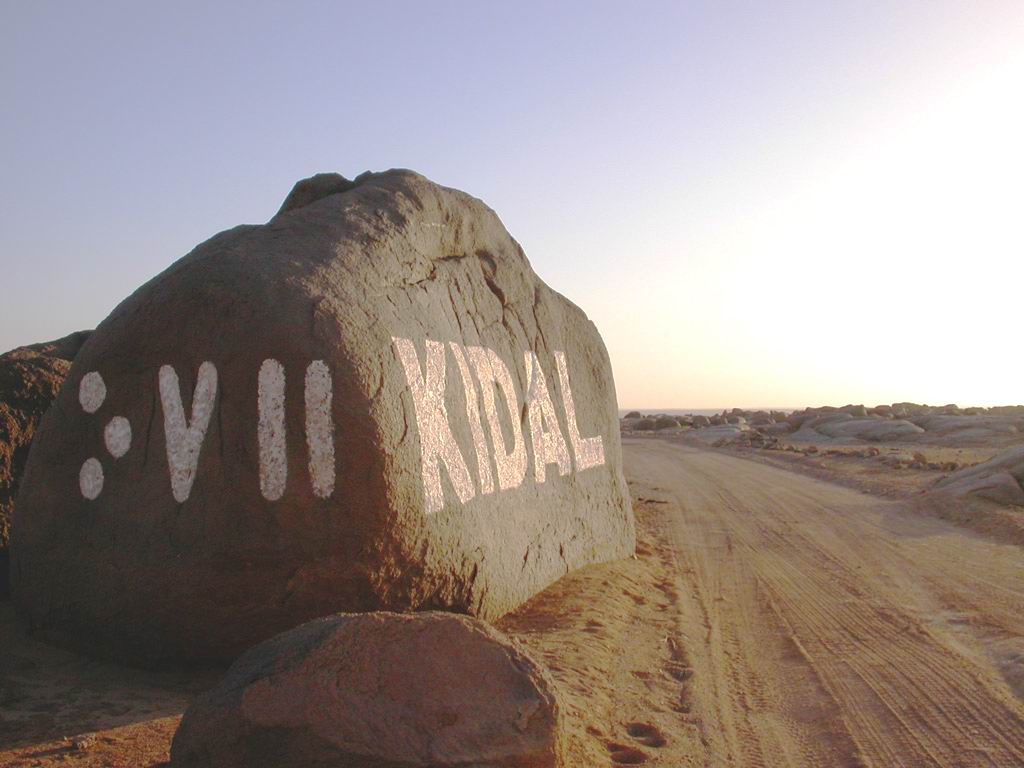
On 25 April 2026, Mali appeared to enter a new and dramatic phase of crisis. Explosions and gunfire were reported around Bamako and Kati, while attacks struck several parts of the country. In the north, Kidal once again became a symbol of state fragility and armed contestation.
Yet this was not an isolated incident. It was the eruption of accumulated grievances rooted in a much longer history of marginalisation. To understand why Mali is once again facing such a crisis, we need to return not only to the 2012–2013 war, but further back — to the colonial and postcolonial arrangements that made northern Mali a periphery to be governed, secured, and repeatedly abandoned. This article argues that the crisis of April 2026 is not a rupture from Mali’s recent past, but the renewed visibility of a question that never disappeared: Azawad.
Entry of Kidal, a city in northern Mali. On the left, Kidal is written in Tifinagh script.
The situation in Mali is still unfolding and much is unclear. Some facts, however, are stark: on 26 April, Mali’s Defence Minister Sadio Camara was killed in a suicide attack on his home — one of the most consequential political assassinations the country has seen in years.
Two distinct forces have claimed responsibility for the broader wave of attacks: the Azawad Liberation Front (FLA), a predominantly Tuareg movement seeking independence for northern Mali, and JNIM (Jama’at Nusrat al-Islam wal-Muslimin), an Al-Qaeda-affiliated militant group that identifies with Al-Qaeda’s strategy of armed ‘global jihad’: a transnational ideological current, that claims to severs the ties between Islamic practice and specific territories or communitiesTreating the FLA and the JNIM as a single actor is a mistake — yet the dominant security framing in international coverage risks doing exactly that. Their alliance of convenience obscures fundamentally different, and in many ways competing, agendas. Still, the image of a collapsing state besieged simultaneously by separatists and jihadists has made it easy to reach for a familiar narrative: Mali is falling apart, and terrorism and rebellion have joined hands.
That framing is not new, and that is precisely the problem. In 2012, the National Movement for the Liberation of Azawad (MNLA) — a predominantly Tuareg political movement rooted in decades of marginalization declared independence for northern Mali. For a brief moment, Azawad existed as a political question demanding a political answer.
That moment did not last. As militant Islamic groups, including Ansar Dine and what would become JNIM, swept across the north and effectively sidelined the MNLA, the international reading of the crisis shifted decisively. The Tuareg independence movement was no longer the main focus of the Malian government, but rather background noise in a counter-terrorism operation against other actors in the north of the country.
France’s military intervention in January 2013 — Operation Serval — crystallised this transformation. An analysis of French government documents from this period reveals a striking pattern: the language of territorial integrity, sovereignty, and terrorism dominates, while the underlying political grievances of northern communities are systematically absent.
This is not merely an analytical observation. In a speech to the French National Assembly on 30 January 2013, Defence Minister Jean-Yves Le Drian described the situation in Kidal in telling terms: French forces had maintained, he said, ‘relations de bonne intelligence’ [well-informed relations] with representatives of ‘le monde touareg’ [the Touareg community] — a phrase that reveals much. The phrasing suggests a relationship less of political negotiation than of careful management.
The MNLA, despite being a secular nationalist movement with a stated willingness to negotiate, received no meaningful diplomatic engagement from Paris. The war on terror had its own grammar, and political dialogue did not fit.
The consequences were structural. By framing the crisis as a security emergency rather than a political dispute, the international response foreclosed the very conversations that might have addressed Azawad’s status. The question was not resolved — it was suppressed.
The 2015 Algiers Accord, which was brokered by Algeria and signed between the Malian government and a coalition of northern armed groups, including the MNLA, promised decentralisation, integration of former fighters, and greater autonomy for the north. France was not a party to the Accord; the diplomatic framework had shifted from Paris to Algiers.
The political status of northern Mali — who governs it, under what arrangement, and with what degree of autonomy — was never genuinely resolved. The Accord managed the conflict without addressing its roots. As the Malian state grew increasingly unstable through successive coups in 2020 and 2021, and as the military government expelled the UN peacekeeping mission MINUSMA in 2023 and turned instead to Russian security support, relations between Bamako and northern armed groups deteriorated sharply. The juntas that came to power framed their seizure of authority in the language of sovereignty and anti-colonialism — presenting France and the international community not as partners but as obstacles to Malian self-determination. On 25 January 2024, the military government formally withdrew from the Algiers Accord altogether. By 2025, the fragile ceasefire had effectively collapsed.
What happened in April 2026 is not a new crisis. It is the return of an old one — the same question, in a more explosive form.
Imposed Lines
To understand Azawad, one must look further back than 2012. The colonial borders dividing Mali, Algeria, Niger and Libya cut across Tuareg networks of movement, trade and kinship. What became international borders were, for many Saharan communities, imposed lines across older social worlds.
Modern states have consistently struggled to accommodate this mobility. Since independence in 1960, successive Malian governments failed to deliver basic infrastructure, services, or economic investment to northern communities — grievances that Tuareg leaders cited repeatedly as the root cause of each successive rebellion. When the state did intervene, it did so with force rather than governance. Movement across borders — a historical practice and economic necessity — has repeatedly been read through the lens of security: as smuggling, as insurgency, as threat. The Tuareg relationship to the Saharan space has thus been governed, surveilled and criminalised rather than understood on its own terms.
This is why Azawad cannot be reduced to ethnic separatism. At its core, it is a question of sovereignty — of who has the right to define territory, movement and belonging. It is also, crucially, not a Tuareg question alone. Northern Mali is home to Songhai, Arab and Fulani communities whose relationships to the state, to armed groups, and to the idea of Azawad itself are distinct and often contested. Any political solution must reckon with this complexity — not flatten it.
The temptation, in moments of acute crisis, is to reach for the security frame. It is familiar, it is actionable, and it offers the clarity that politics rarely does. But applying a single counter-terrorism logic to what is happening in Mali today risks repeating the same mistake made in 2013.
JNIM and the FLA are not the same actor — one transnational and ideological, the other rooted in the specific territorial grievances of northern Mali. Treating them as interchangeable — as a unified threat to be defeated — obscures precisely what needs to be understood. When political grievance is rendered invisible, it does not disappear. It finds other expressions.
The history of northern Mali since 2012 is, in many ways, a history of security operations that ended battles without ending the conflict. Each intervention bought time; none addressed the question of what northern communities are owed — in terms of political recognition, economic inclusion, and land rights.
The Azawad question has not returned because it never truly disappeared. It was renamed as terrorism, postponed, and ultimately denied as a political question. The events of April 2026 show the limits of that denial.
The post Azawad Never Left: Reading Mali’s 2026 Crisis Through 2012 appeared first on African Arguments.