Chiwenga, Mohadi miss crucial Zanu PF politburo meeting
Presidency insists nothing amiss with absence from key politburo meeting before parliament votes on constitutional amendment
 Black News
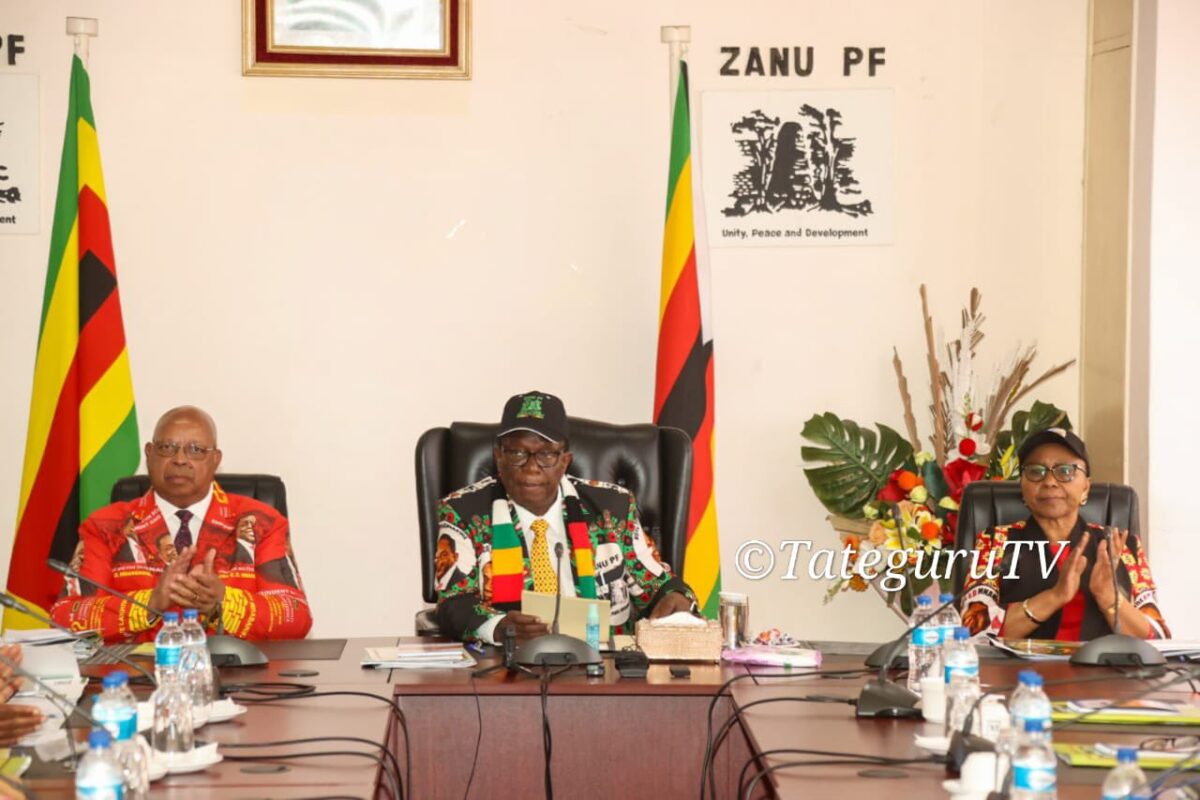 President Emmerson Mnangagwa appeared at Zanu PF politburo meeting flanked by secretary general Jacob Mudenda and chairperson Oppah Muchinguri on May 6, 2026
HARARE – A Zanu PF politburo meeting billed as potentially explosive proceeded without the two vice presidents in Harare on Wednesday, as the party’s top decision-making body gathered for its last session before parliament votes on sweeping constitutional amendments that would also extend President Emmerson Mnangagwa’s rule.
Vice President Constantino Chiwenga reportedly opposes the changes, while Vice President Kembo Mohadi has been non-committal.
Mnangagwa appeared at the meeting flanked by Zanu PF secretary Jacob Mudenda and party chair Oppah Muchinguri, where otherwise Chiwenga and Mohadi would have sat.
In public comments while reporters were present, Mnangagwa made no reference to the push for his term extension.
Presidency spokesman George Charamba told ZimLive the two deputies were “on government assignments,” declining to elaborate.
Zanu PF’s politburo, the main decision-making body between party congresses, meets once at the beginning of every month. Wednesday’s gathering was the last before the parliamentary vote – a moment critics say will determine whether Zimbabwe’s post-Mugabe constitutional order survives its most serious test since the new constitution was adopted in 2013.
The Constitution of Zimbabwe Amendment (No. 3) Bill, gazetted on February 16, proposes extending presidential and parliamentary terms from five to seven years, replacing the direct popular election of the president with election by a joint sitting of parliament, and enlarging the Senate from 80 to 90 members – with the president empowered to appoint 10 additional senators.
Transitional provisions state that the new seven-year term would apply to the continuation in office of the current president, notwithstanding the general prohibition on the retroactive amendment of term limits under section 328(7) of the constitution.
In practical terms, the bill would keep Mnangagwa in office until 2030, two years beyond the 2028 expiry date of his current and constitutionally final term.
He turns 84 this year.
The bill would also abolish the Zimbabwe Gender Commission and the National Peace and Reconciliation Commission, transferring their functions to the Zimbabwe Human Rights Commission, and strip the Zimbabwe Electoral Commission of its responsibility for the voters’ roll, handing it to the Registrar-General.
The government has framed the changes as modernising reforms. A cabinet statement said the amendments, if passed, would “enhance political stability and policy continuity to allow development programmes to be implemented to completion.”
Critics, however, say the bill should be subjected to a national referendum, and that the consultative hearings – held over just four days, on weekdays, at a limited number of venues – were rushed and exclusionary.
With Zanu PF holding a commanding parliamentary majority, the bill is widely expected to pass.
The political temperature around the amendment spilled across the border last Sunday, when Mnangagwa received South African President Cyril Ramaphosa at his farm surrounded by his business acolytes, with neither of his deputies present.
The informal nature of the gathering at Mnangagwa’s 450-hectare Pricabe farm outside Kwekwe has drawn criticism in both countries. The South African presidency said on Thursday it had “noted with concern” that Ramaphosa had flown on a military helicopter to Kwekwe alongside Mnangagwa and “a person of interest” to South African law enforcement – a reference to the tenderpreneur Wicknell Chivayo, who is under investigation for alleged money laundering over payments linked to Zimbabwe’s 2023 election procurement.
Also aboard the short flight was Kudakwashe Tagwirei, a petroleum tycoon under United States and British sanctions whose vast wealth, built largely on state contracts, is fuelling his ambitions to succeed Mnangagwa.
Tagwirei, it is alleged, hopes his proximity to Mnangagwa can propel him to high office, crossing swords with Chiwenga who accuses him and Chivayo of “capturing the state.”
It has been reported that Ramaphosa urged Mnangagwa to abandon the constitutional amendment, offering in return to secure him guarantees of safety and immunity from his would-be successor – who, under the current Zanu PF hierarchy, would be Chiwenga.