‘No one asked us’: West Coast fishers oppose offshore oil and gas development
From Doringbaai to Port Nolloth, West Coast communities are pushing back against mining and offshore oil and gas expansion. Residents, activists and fishers say consultation processes fail local people while environmental degradation and economic inequality continue to deepen
 Black News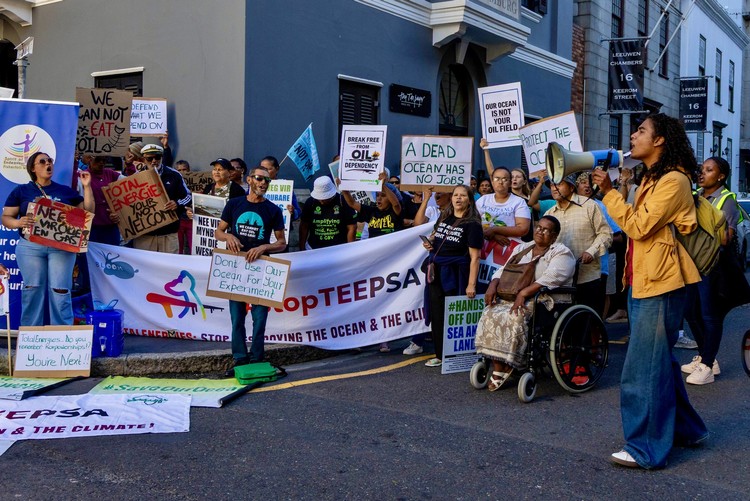
Pedro Engelbrecht, the chairperson of the Doringbaai Fisheries Cooperative, stood on a fishing jetty in the West Coast village of Doringbaai, the Atlantic Ocean beneath his feet, as he explained why many in his community oppose planned oil and gas projects offshore.
“The minister says that we can live from oil — but they are the ones who are going to live from oil, not us, because it has a terrible effect on us as fishers. It’s those big oil companies and the minister who benefit.”
Engelbrecht was referring to Minister of Mineral and Petroleum Resources Gwede Mantashe, who has long supported the expansion of oil and gas development in South Africa.
His scepticism was echoed by community leaders, fishers, former miners and activists interviewed during a 10-day reporting trip in December 2025.
The journey covered Doringbaai, Papendorp, Ebenhaeser, Lutzville and Port Nolloth, with additional input from a Hondeklipbaai community leader interviewed online.
The reporting trip was supported by Greenpeace Africa, which covered travel and logistical costs. The author also produced a separate narrative series for Greenpeace Africa. This article was independently reported and edited.
Mining for copper, diamonds, sand, phosphates and other resources has taken place along the West Coast for more than 150 years. Prospecting for oil and gas is now expanding offshore along much of the coastline.
A court case against TotalEnergies is under way, in which the Port Nolloth Aukotowa Fisheries Cooperative, together with the Green Connection and Natural Justice, is opposing the company’s planned oil and gas projects in the Orange Basin. The applicants argue that communities were not adequately consulted. Judgment has been reserved.

Coastline mapped for oil and gas
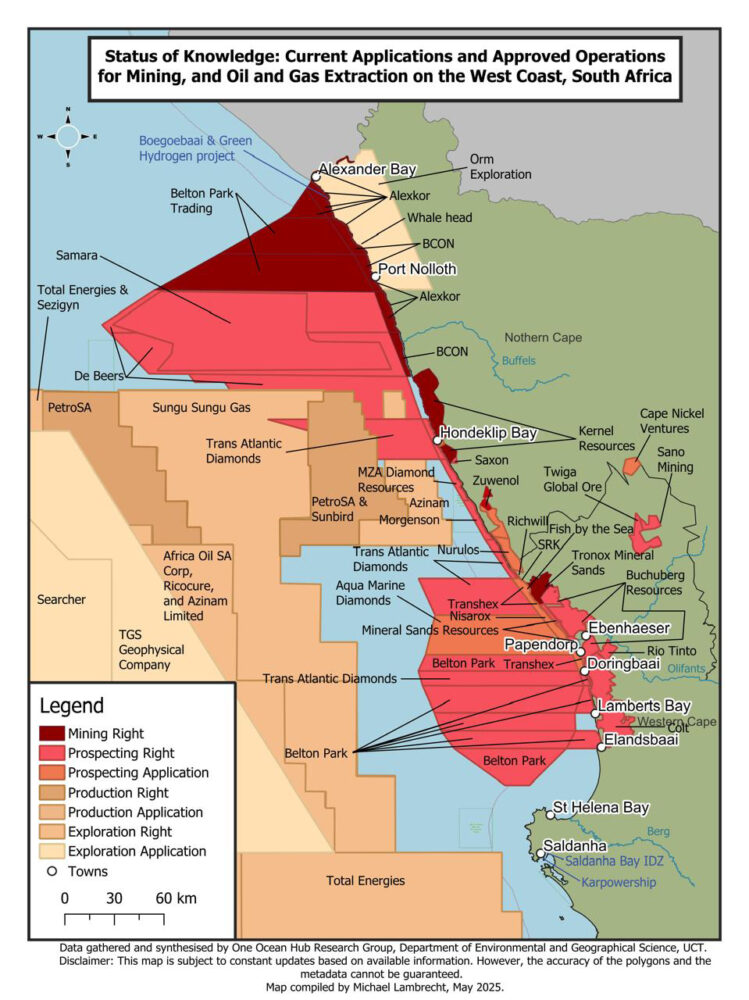
About 95% of South Africa’s exclusive economic ocean zone has been mapped by the department of mineral and petroleum resources (DMPR) for oil and gas exploration, with the stated aim of boosting socio-economic development and creating jobs.
Along the West Coast, land-based and offshore mining extends along most of the coastline, while oil and gas exploration extends further offshore.
Politicians across the country’s political spectrum have expressed support for new oil and gas developments.
The government’s Operation Phakisa, part of the National Development Plan, aims to address inequality, poverty and unemployment through oil, gas and marine aquaculture development.
The DMPR says mining contributed 6.1% to South Africa’s GDP in the 2024 financial year and created 474 736 direct jobs. Mining royalties and taxes contributed about R60 billion, or roughly 3% of total national tax revenue. Mantashe has said that oil and gas development could increase GDP by up to 8%.
However, Tony Leiman, emeritus professor of economics at the University of Cape Town, noted that such estimates were “unduly optimistic”. While oil and gas could support fiscal expansion and economic benefits, he said the government would need to ensure benefits were fairly distributed nationally.
A study of 12 sub-Saharan African countries that explored oil and gas between 2001 and 2020 found that projected revenues were not achieved in several cases — income was up to 63% lower than forecasts.
Under the Mineral and Petroleum Resources Development Act (MPRDA), mining and energy companies are required to undertake social responsibility projects intended to ensure local benefit from extraction activities.
TotalEnergies, one of the companies prospecting offshore, said in response to written questions that it “has invested $0.5 million [R9 million] in around 20 projects that benefited 11 500 community members along the West Coast, in the vicinity of its offshore blocks”.
The extent to which the investment translates into meaningful long-term development is contested by community members.
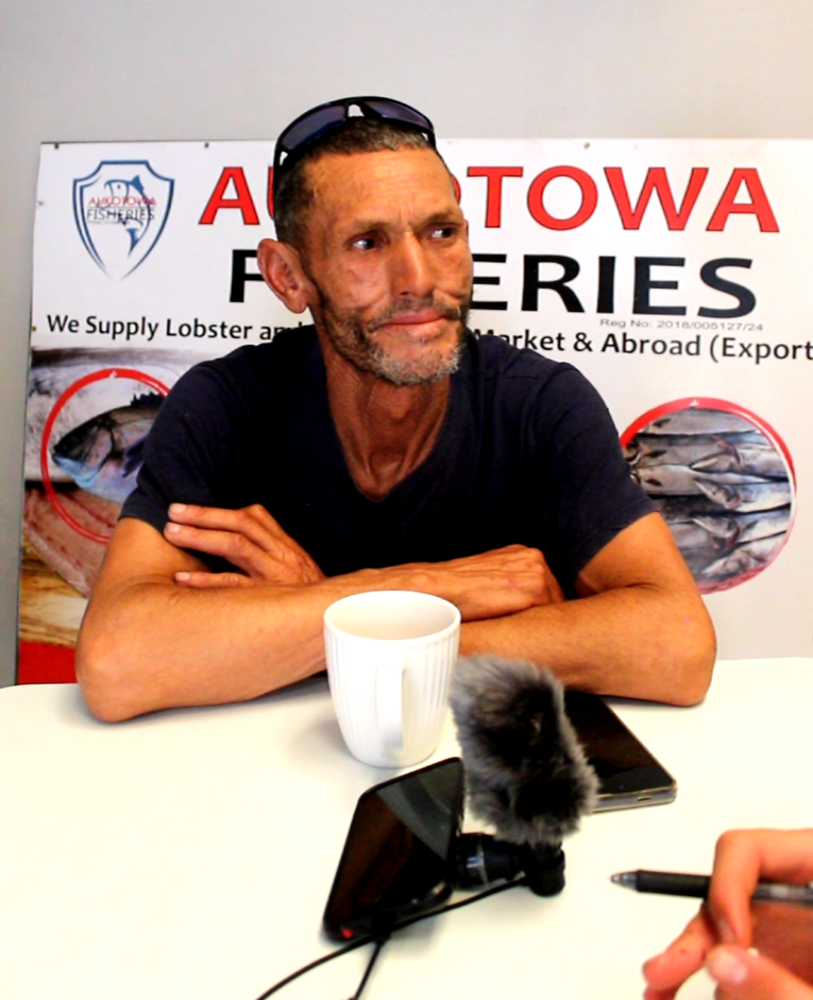
Walter Steenkamp, a fourth-generation fisher in Port Nolloth and chairperson of the Aukotowa Fisheries Cooperative, questioned the company’s claims.
“The only benefit was that Hondeklipbaai got a vegetable garden. Port Nolloth municipality received firefighter uniforms. They promised an internet café in Hondeklipbaai but nothing came of it.”
He added that drilling activity had environmental consequences for fishing communities. “Only a year after TotalEnergies’ drilling near Hondeklipbaai, there was no snoek left in Hondeklipbaai.”

‘We have the right to say no’
Port Nolloth is the economic centre of the Richtersveld municipality and a historic hub for copper mining and the continuing diamond mining.
While recent unemployment statistics are unavailable, the municipality’s draft integrated development plan highlights “skew patterns of wealth distribution, relatively high levels of unemployment and crime”.
The plan also aims to promote local economic development through industrial and resource-based projects.
“For whom is the development?” Steenkamp asked. “Definitely not for us. And that’s why we have the right to say no. We get left out.
“Oil and gas, it’s not for us. We will be slaves for the people like all the years and we will just be going to do the work,” he said, referring to low wages and unequal distribution of mining profits.
A 2023 historical analysis by the Transnational Institute found that although billions of rand have been extracted from the West Coast, poverty and inequality remain high.
The report also found that while mining provides some employment, it is associated with environmental degradation, loss of traditional livelihoods and widening inequality.
From a macroeconomic perspective, 2025 PwC data (figure 1 below) compiled by Christopher Rutledge shows that tax revenue does not increase proportionately with corporate mining profits — companies capture most of the economic gains.
Rutledge is the executive director of the Mining Affected Communities United in Action and Women Affected by Mining United in Action advice office.
Livelihoods under pressure
Many West Coast towns share similar socio-economic conditions, with livelihoods heavily dependent on the ocean.
In Doringbaai, a fishing village surrounded by mining operations and prospecting applications, Deborah Dewee, the leader of the Spirit of Endeavour Fisherfolk Women group, said communities bore the environmental costs of extraction.
She pointed to declining fish stocks linked to offshore diamond and phosphate mining, as well as onshore mineral extraction.
“When all these resources and livestock in the ocean die, what good is money going to do for you? You can have that money but if the land is destroyed and the ocean is destroyed, then you can’t buy food. This is where the food comes from.”
Economists describe such impacts as negative externalities.
Professor Patrick Bond, the director of the University of Johannesburg’s Centre for Social Change, said greenhouse gas emissions from extractive industries cost South Africa about $95 billion (R1.5 trillion) annually in climate-related damages, including extreme weather events, wildfires and agricultural disruption.
The costs, he said, should be included in any cost-benefit analysis of oil and gas development.
‘No one asked me since the day I was born’
All fishers interviewed expressed concern that their livelihoods could disappear and frustration over what they describe as inadequate consultation.
Jimmy Arendse, a lifelong fisher from Doringbaai, said: “No one asked me since the day I was born. They just do what they want.”
Both the Constitution and the MPRDA require that development promotes ecological sustainability and includes meaningful consultation with affected communities.
The Constitution provides for “ecologically sustainable development and use of natural resources that must promote justifiable economic and social development”. The MPRDA requires consultation with interested and affected parties before mining or oil and gas activities can proceed.
TotalEnergies said it was “fully committed to complying with all applicable South African legislation, including the National Environmental Management Act and its associated Environmental Impact Assessment Regulations”.
However, community leaders argue that consultation processes are often ineffective and largely procedural. They say approvals frequently proceed despite opposition, while legal challenges remain costly and inaccessible.
Legal precedent exists. Shell’s offshore exploration off South Africa’s east coast was halted by the high court in the Eastern Cape in 2022 because of inadequate public consultation. Environmental attorney Cormac Cullinan said at the time that procedural failures, particularly consultation, were often decisive in such cases.
TotalEnergies said it had conducted more than 450 meetings over four years, reaching nearly 15 000 people with the support of independent environmental assessment practitioners.
The DMPR did not respond to requests for comment by the time of publication.
Decline and adaptation
Abandoned infrastructure along the coastline reflects broader economic decline described by communities.
Robert Odendaal, a retired school principal in Port Nolloth, comes from a fishing family with generations of ties to the fish factory, which closed in 1993 and stands abandoned.
Rusting industrial tanks nearby once supported offshore mining operations.
Community members say commercial overfishing and pollution have contributed to declining fish stocks.
The Masifundise Development Trust, which advocates for coastal food sovereignty, said such infrastructure reflected a pattern in which companies extracted resources and left without long-term benefits.
‘Let the people guide you’
In response to declining livelihoods, some communities are turning to food security initiatives such as communal vegetable gardens.
Dewee’s women’s group runs a garden that supplies a soup kitchen. “Our bodies need pure, healthy, natural food, not toxic oil food, not gas food. That’s the only way to survive.”
She urged decision-makers to engage directly with communities.
“Come to Doringbaai so you can hear from the fishers, the indigenous fishers, how they feel about their food security. They will destroy everything and I don’t know how Doringbaai’s fishers will survive.”
Joe, an anti-mining activist from Port Nolloth who requested a pseudonym, said top-down decision-making ignored local realities.
“The top-down approach is a killer,” he said. “Those leaders don’t have first-hand experience on a grassroots level, they sit in an office.”
His advice to policymakers is simple: “They must come to the areas where they want oil and gas and find out what is actually happening here. They must visit every community in South Africa to understand the experiences of the area and the people.”