Small wins for African penguins amid a sharp population decline
Last Friday, a female African penguin was successfully released back into the wild on Halifax Island near Lüderitz. Named AP002, the penguin was cared for by the Namibian Foundation for the Conservation of Seabirds (Namcob) for 49 days before she was ready to return to her family. Rescued as an underweight chick, dedicated care saw […] The post Small wins for African penguins amid a sharp population decline appeared first on The Namibian.
 Black News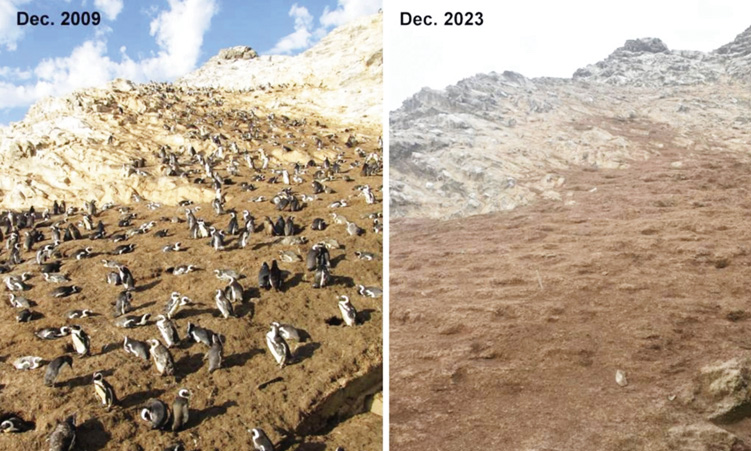
Last Friday, a female African penguin was successfully released back into the wild on Halifax Island near Lüderitz.
Named AP002, the penguin was cared for by the Namibian Foundation for the Conservation of Seabirds (Namcob) for 49 days before she was ready to return to her family.
Rescued as an underweight chick, dedicated care saw her quickly gain weight and become a healthy young penguin.
Penguins are only released back into the wild when they are in good condition and have waterproof feathers.
Every single rehabilitated penguin is a big success given the serious situation penguins face.
With less than 10 000 breeding pairs left, Africa’s only penguin species was the first and only penguin worldwide to be listed as Critically Endangered on the IUCN Red List in October 2024.
Experts say if nothing changes the species could be extinct in the wild by 2035.
ALARMING
African penguins only breed in South Africa and Namibia. But Namibia has only a small share of the total population, and their numbers are dropping fast.
In 1979, there were almost 9 000 breeding pairs in Namibia.
That number fell to about 6 000 in 2003, and to less than 1 500 in 2023.
This is a decline of more than 82% in Namibia alone.
Combined with South Africa, the entire population has fallen by 97% over the last century.
A closer look at Namibia’s main breeding islands, shows an even more alarming picture.
In 2010, more than 3 500 breeding pairs lived on Mercury Island. By 2020, just over 1 800 remained, dropping to eight pairs in 2022 and none in the most recent count in 2025.
Ichaboe Island had 660 pairs in 2010, already a sharp drop from more than 2 200 in 2001, and only 20 in 2022.
These numbers have recovered slightly, reaching 66 breeding pairs last year.
Possession Island had the strongest population of the three in 2025, with 549 pairs, down from 1 200 in 2015.
REASONS
Beyond past threats like hunting, egg collection and guano harvesting, the species now faces a variety of modern factors that exacerbate one another.
Overfishing of their main food sources – sardines and anchovies – has reduced the amount of prey available to them.
At the same time, climate change is increasing extreme weather and warming ocean temperatures, causing their food to move further away from breeding areas.
Diseases such as avian influenza, as well as oil and noise pollution with human disturbance from the nearby harbour at Lüderitz, are added pressures.
Penguins have also fallen prey to other predators, including seals, because of food shortages.
SIGHTINGS
African penguins are occasionally seen at Walvis Bay and Swakopmund.
This year, 20 sightings have been reported by members of the public and tour boats.
Some of these birds are lost, weak or starving, as their natural instinct leads them north in search of sardines.
However, because of overfishing and climate change, fish stocks have dropped sharply, and the penguins often can’t find enough food to make it back south.

Given the alarming situation of African penguin populations in Namibia, the public is urged to report any penguins seen out of the water to Namcob or Ocean Conservation Namibia (OCN).
OCN is the contact point on the central coast for seabirds in distress.
Penguins out of the water are vulnerable and need care to recover. They are then returned to Namcob at Lüderitz, where they can be released back to their breeding colonies.
- Damian Schreiber, marine conservation communications, field and research officer at Ocean Conservation Namibia; he is involved in seal rescues, education outreach and beach clean-ups. He has a master’s in ecology and society from Costa Rica’s University for Peace.
The post Small wins for African penguins amid a sharp population decline appeared first on The Namibian.