The Bros of Comedy
Owen Benjamin lives in Idaho, pumps his own water, raises goats and advocates for a back-to-the-land, conservative Christian lifestyle. He The post The Bros of Comedy appeared first on Moment Magazine.
 Black News
Owen Benjamin lives in Idaho, pumps his own water, raises goats and advocates for a back-to-the-land, conservative Christian lifestyle. He is, improbably enough, a comedian. “Comedy has a way of showing you the truth better than [anything] I’ve ever seen,” he says. Benjamin’s particular brand of humor is delivered via video livestreams he produces from his home studio or from the front seat of his truck. In them, he like to promote various conspiratorial notions, i.e. the Big Bang theory is flimsy, the moon landing maybe never happened (“They went to the moon a few times, from 1969 to 1972, and then they lost the ability to go back?”) and that there was no Holocaust. (“There were atrocities, of course, but not these millions and millions.”)
Benjamin, who was banned from Instagram and YouTube in 2019 for posting antisemitic memes, uploads his content on Unauthorized.tv, a subscription-based alternative to YouTube featuring personalities like “Flat Earth Dave” and Vivian Kubrick, the late film director Stanley Kubrick’s daughter, who warns against wokeism and world government. “As a comedian, I like to antagonize people,” Benjamin said during a visit with podcaster and former mixed martial arts fighter Jake Shields. “I called the CEO of YouTube an ugly ‘J.’”
“J” is many antisemitic podcasters’ not-so-secret code for Jews, used to circumvent automated content flags and to make it harder for their critics to search for their slurs online. On Shields’ show, Benjamin and the host traded attacks on Jews. “What got me to mock J’s,” he explained, was seeing how Jewish groups try to “tell me how to live.”
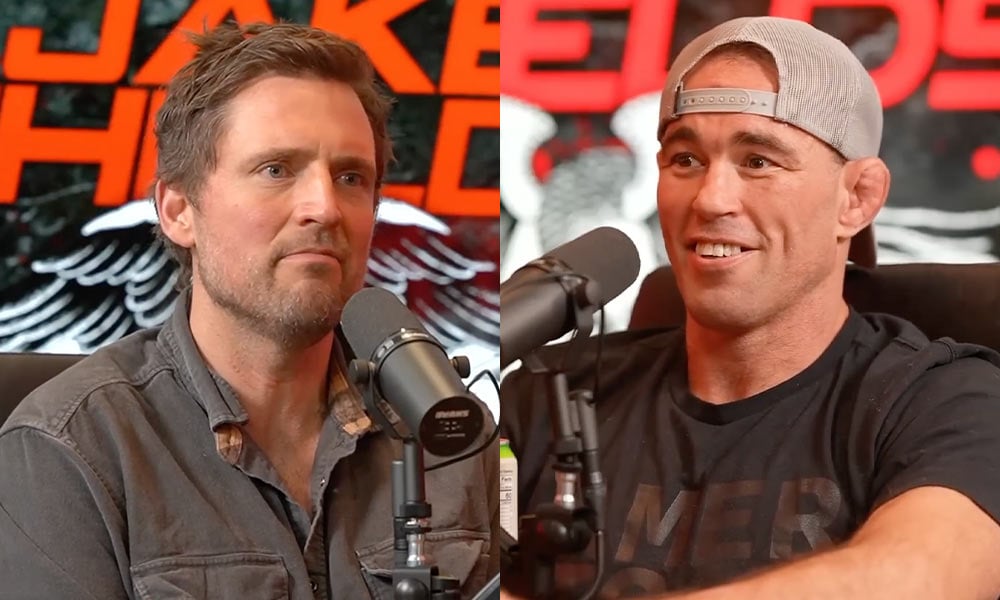
Owen Benjamin (left) and Jake Shields (right) On Shields’ show in October 2024. Credit: Youtube Screenshot
In an era of enduring political and social division, it was perhaps inevitable that even comedy, the slice of life dedicated to making us all laugh together, would cleave into the ideological silos that the internet age has erected so efficiently. Far from seeking common ground as comedians did in the decades following World War II, many of today’s performers—and their audiences—relish their seclusion in comfortable bubbles of like-minded people. Comedians now find themselves frequently categorized as right-wing or left-wing, often appearing in media that cater only to one side of the nation’s political chasm. For many comedians, this is both a political reality and financially beneficial.
“Comedians today are economically obliged to pick their audience and break it off to serve the demands of the algorithm, and the most effective way to do that slicing is through politics,” says Matt Sienkiewicz, the director of Jewish Studies at Boston College and author of That’s Not Funny: How the Right Makes Comedy Work for Them. “Who can come up in this era without picking a political lane?”
Comedians were early adopters of social media, churning out the hot takes and memes that can pave the path to virality and financial success. From Twitter, many comedians jumped to podcasts, mimicking the model set by comic-turned-podcaster Joe Rogan, who launched The Joe Rogan Experience in 2009 and added video in 2013. He and his show’s guests honed a new format, a latter-day variant of right-wing talk radio mixing yuks with punditry and polemics. Comedy-forward political podcasts blossomed in good part because of their perfect timing: Just as Rogan and his acolytes were putting their hours-long chatfests on YouTube and other platforms, voters were embracing Donald Trump’s and Bernie Sanders’ populist campaigns against the elites they blamed for steering the country off the rails. (Rogan embraced Sanders’ presidential bid in 2020, then switched to Trump in 2024. More recently, he has been critical of Trump’s second-term behavior.) Trump and his MAGA movement latched onto pre-existing resentments against “language police” and “political correctness,” combining those frustrations with skepticism about science, medicine, academia, the news media and other major institutions—all lending themselves to sharp-edged comic attacks.
This new generation of comedians win their audience primarily through video podcasts—an online remake of the old-fashioned talk show, now mostly hosted by young, right-wing men. Visibility in this sphere can lead to invitations to studio chat tables across the political spectrum, from the liberal The Young Turks podcast to Fox News’s Gutfeld!, as if they are political commentators or even public intellectuals—though the attention comes not from the quality of their professional achievements or knowledge but from their talent with punchlines. “The nature of the podcast is that people just sitting around talking are just as valid as experts,” says Sienkiewicz.
Noam Dworman, who owns the Comedy Cellar nightclub in Greenwich Village agrees that comedy video podcasts have become a way to create content specifically for sharply politically-siloed audiences, adding that content is primarily consumed through “microcasting”—the use of short clips to maximize virality. “Before the internet, we had gatekeepers and limits on free speech, in the form of the limited number of TV stations and clubs,” he says. “We always had the Weekly World News,” (the tabloid paper that made the National Enquirer look sober) “but we knew the difference between that content and CBS News.” Today’s podcast audiences relish the performers’ “mix of charm and charisma and conspiracy theories,” Dworman says, with disturbing results: “Today, people are very easily led astray.”
***
Jake Shields’ interview with Owen Benjamin, which originally aired in October 2024, has drawn a little over 740,000 views on YouTube, a far cry from Rogan’s millions of clicks, but the burgeoning network of comedian-podcasters has forged a direct connection between such smaller-scale performers and the big guys. Shields, based in Las Vegas, has over 900,000 followers on X. Despite his gentle demeanor, he rails against Jews at every opportunity. Shields has on several occasions hosted the comedian Dave Smith, who is Jewish and has turned his own podcasts and performances into an outlet for anti-Israel comedians and political commentators alike. Featuring such a prominent Jewish guest has led some of Shields’ fans to blast him as a traitor to their cause. Shields pushed back, posting that he and Smith “have a few differences in beliefs (Hitler), but Dave has fought harder than almost anyone for the people of Palestine. Jews hate Dave with a passion for being a ‘race traitor.’ Why attack a man on our side?”
Smith, a frequent guest on The Joe Rogan Experience, is seemingly omnipresent on the right-wing web. The 42-year-old Jewish comedian has over 900,000 followers on X and 44 million views of his videos; he has become a focal point in a broader argument among right-wing podcasters over whether comedians—especially Jewish ones—should use their popularity to argue for their political positions, whether on presidential campaigns or conflict in the Mideast.
Smith has no compunctions about hosting guests on his Part of the Problem podcast such as the white nationalist leader Nick Fuentes and conspiracy theorist Candace Owens, whose remarks about “rings” of Jews in Hollywood and Washington, DC, committing “horrific” acts didn’t seem to bother Smith at all. Smith says he doesn’t necessarily agree with everyone he hosts and he welcomes disagreements.
In his home neighborhood of Park Slope, “I was kind of a left-wing kid, because I grew up in that environment,” Smith said in a 2017 interview. His highest aspiration back then was to be like George Carlin, the left-leaning comic wordsmith. And even though politics were not high on his family’s conversational agenda, as a youngster, he absorbed what he later called “this unspoken cultural value” that puts bigotry “at the absolute top of the hierarchy of outrages.” Over the years, under the influence of Rep. Ron Paul of Texas and other libertarians, Smith came to view bigotry as “something we all have in excess. I think it’s bad. But there’s much worse things than that.” Chief among those worse things for him is war, and the Iraq war turned Smith from a more traditional stand-up into a politics-first performer.
By 2024, Smith’s self-conception had shifted further, to the point that he considered a run for president on a Libertarian ticket: “I’m a weird guy: I tell jokes at nightclubs and then get obsessed with politics and monetary policy,” he said on Rogan’s show. “I just, like, fundamentally disagree with this idea…that there’s an expert class [who alone] can have opinions on all of these things.”
Instead, Smith, who graduated from The State University of New York at Albany with a degree in history, sought on his podcasts to amplify voices who were at once reliably antiwar, entertaining and enormously provocative. This included Fuentes. “I felt like this was a show that was supposed to happen,” Smith said at the start of a three-and-a-half-hour episode of his Part of the Problem podcast last October. What Smith had anticipated would be a debate turned into something far friendlier. “We ended up nerding out on the stuff that we both enjoy,” he said, later calling Fuentes a “fellow traveler.”
“We have a lot of overlap in our audience,” Smith told Fuentes.
They agreed that they both represented “the Israel-critical side” and they bonded over their antiwar credentials. “Yeah, maybe I’m racist,” Fuentes said. “Maybe we disagree on issues of race, but I’m against murder. I’m against genocide.”
Smith has said that “what comics do best is call bullshit,” yet he defends his decision to provide Fuentes and his ilk with a platform as simply a matter of being friends with people with whom he sometimes disagrees. Smith said he’s even remained friends with people who supported Israel’s prosecution of the war, “and I actually think that’s a much worse opinion to have than to hate Blacks or hate Jews or hate anyone,” he said.
Smith’s episode with Fuentes raked in more than two million views.
***
For decades, from nightclubs and TV gabfests to arena shows and Netflix specials, comedy was assumed by many Americans to be inherently liberal, lumped together with journalism and academia as fields to which people were drawn in part because they emphasized empathy for the underdog. Although mid-20th-century comedy was largely apolitical or blandly patriotic—think Bob Hope, Milton Berle, Johnny Carson—the political and social upheavals of the 1960s and 1970s led to an explosion of material about the toughest of topics: civil rights, the sexual revolution, nuclear bombs, the Vietnam War. Among Jewish comedians, edgy young performers steered away from the broad, family-friendly material favored by the Borscht Belt stalwarts who rose to fame early in the TV era. The newcomers were reliably liberal, whether they were social commentators such as Mort Sahl or Lenny Bruce, or stand-up comics and sketch writers like David Steinberg, Elaine May and Mike Nichols.
But although that rebellious, antiauthority brand of comedy has remained closely associated with liberal politics in a tradition that extends to Saturday Night Live and Jon Stewart’s The Daily Show, the emergence of a sprawling right-wing comedy community shouldn’t come as a surprise. Boston College’s Sienkiewicz, along with other scholars of comedy, argues that there’s nothing fundamentally left-leaning about the form. “That’s just a bedtime story that liberals tell themselves,” he says. “Pushing back against authority has always been part of comedy, but that doesn’t have to be from the left. It depends on who’s in authority.”
Comedy is intrinsically iconoclastic, not liberal, says Dworman, the Comedy Cellar owner. “What makes things funny is often when people are taking down shibboleths,” he tells me. “For many years, that made comedians skew liberal. In that period, it was deep in the culture of the left to respect people’s right to say whatever they wanted. And then it changed. The left got so ridiculous with rules about what people can say that it was only natural for comedians to take the opposite side. Nobody wants to be policed.”
Dworman, whose 115-seat club has featured A-list comedians such as Dave Chappelle, Jon Stewart, Chris Rock and Amy Schumer, as well as countless unknowns, is a lawyer who left the profession to run the family business, the club his father Manny launched in 1980.
From its start, and even before that in Manny’s Cafe Feenjon in the same space, the Comedy Cellar joined other New York clubs in presenting a heavy diet of Jewish comics who shied away from political jokes—a reflection of the city’s demographics and the popularity of Jewish and other ethnic humor in the postwar decades. More recently, Noam Dworman, now 62, has seen both the performers and the audience at his club become less Jewish and more political. “Years ago in New York City, there were way more Jews, and being Jewish was much more central to their lifestyles,” he says. “They knew the Yiddish words. Today, it’s not possible to build an act around being Jewish, unless you’re playing just to an Orthodox audience.”
For many Jewish comedians, this has meant a bolder approach to material confronting or parodying antisemitism. In the early 2000s, Sacha Baron Cohen used his racist character Borat to expose his targets’ bigotry. And after her comedy special Sarah Silverman: Jesus Is Magic was released, the comedian said she got a ton of bad press for telling an anti-Asian joke. “It hurt,” she said. “I mean, as a Jew, as a member of the Jewish community, I was really concerned that we were losing control of the media.”
Today’s comedians—Jewish and not—have to cobble together their audiences through both traditional venues and new media outlets. That often leads to a conclusion that they need to go public with their political perspectives, Sienkiewicz says: “Those who don’t have a strong view will pay the price.”
Not every comedian has gone in that direction. Alex Edelman, who grew up Modern Orthodox, burst onto the comedy scene a decade ago as a stand-up and an actor. His 2022 show, Just For Us, moved to Broadway and he made it onto Time magazine’s list of the world’s most influential people the following year. Much of Edelman’s comedy centers on his being Jewish. He reminds audiences about his community being embattled, forever coping with “huge existential issues.” But he uses his Jewish experience to craft bits that reach for the universal, rather than hewing to parochial, insider comedy of the kind that Mason, Alan King or Buddy Hackett honed to delicious perfection.
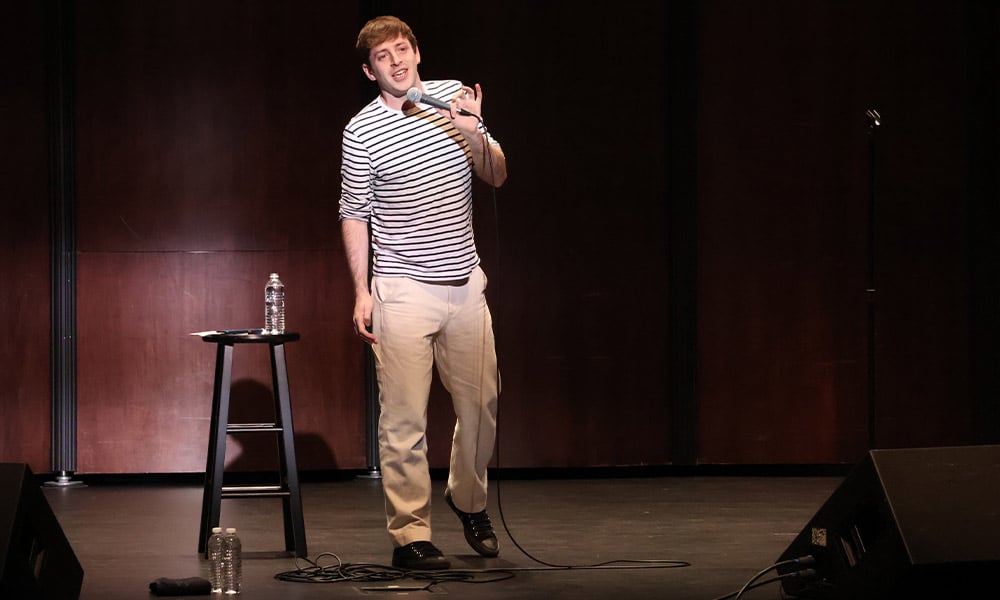
Alex Edelman in January 2024. Credit: Hameltion (CC BY-SA 4.0)
Comedy, Edelman says, is how we test ideas and explore the boundaries of what’s reasonable. He adores how Mel Brooks pushed the envelope in 1967—just two decades after the Holocaust—with The Producers. “Some things are too serious not to joke about,” Edelman has said. “All the power’s in the third rail.”
But in this fractious time, Edelman isn’t eager to touch the third rail of the moment—attitudes toward Israel, specifically among American Jews. He did test a couple of jokes about the Gaza war in appearances at the Comedy Cellar, and audiences seemed okay with them, but he felt uncomfortable. When he told his former agent in Britain about a notion he had to build an entire show around the Israel-Palestine conflict, the agent said, “Oh, great. We should call it ‘Career Suicide.’”
[Read “Two Comedians Bump Into a War” here.]
Edelman’s restraint stems from his internal conflict. “I have complicated feelings about what’s going on in Israel and Gaza and Palestine,” he told The Hollywood Reporter. On the Jewish media podcast Unholy, he explained that “there are some people who are irritated at me because I’m not sufficiently vocal on either side.”
Edelman’s struggle over how to address the war is a common story on the left, but on the right, where outrage is the current coin of the realm, it often seems like nothing’s beyond the pale. The right-wing comedy podcasters see comedy as unvarnished truth—it’s what everyone else really wants to say, but can’t because of political or linguistic boundaries that society has (unfairly!) imposed. In that corner of the comedy landscape, material about Jews—much of it brazenly antisemitic—is playing all too uncomfortably like comedy gold.
***
In 2024, the bro-casts of the comedy manosphere became the premier platform showcasing Trump’s White House comeback: During the campaign, he spent three hours with Rogan (62 million views) and an hour with Theo Von, host of This Past Weekend (17 million views). But in addition to hosting the leader of the free world, Von, a comedian-podcaster who started his media career on reality TV, has made his show a welcoming and uncritical home for extremists.
Von has sought to craft a middlebrow political persona for himself, but when Jewish comedian Roseanne Barr said on his show that Hollywood was an “organized crime network” run by Jews, that she is “not the right kind of Jew for Jews in Hollywood,” and that “nobody died in the Holocaust; that’s the truth,” her words went unchallenged. In responding to Von, comedian Marc Maron demonstrated the increasingly mainstream reach of far-right comedian-podcasters. On his 2025 HBO special, Panicked, Maron quipped that “if Hitler were alive today, he’d probably appear on Theo Von’s podcast. And Theo would be like, ‘See, y’all did a lot of meth, right?…That shit will make you crazy, dawg…Hey, Hitler, you probably didn’t even hate the Jews. That was just the meth making you crazy, dawg.”
Von has called Israel a “terrorist state” and a “satanic regime,” speaking often about his support for the Palestinian cause. “It’s obvious that you can’t go and annihilate and genocide this culture and make them disappear,” he told Candace Owens in an interview in 2025. During the Gaza war, Von, like many comedian-podcasters, took positions that often aligned with his audience’s—or in other cases helped shape their views, since for an increasing number of viewers, podcasts are a primary source of news. According to a poll in September by The Washington Free Beacon, 35 percent of young conservatives (ages 18 to 34) say they get their news about Israel from Rogan’s podcast and 11 percent get such news from Von’s.
That is why the debate on Rogan’s show last April between Dave Smith and Douglas Murray, a pro-Israel journalist who writes a column in London’s Spectator, became such a cultural flashpoint. For three hours, the two went at each other over who gets to speak about difficult political questions. Smith blasted the expert class and touted his longstanding belief that the country gets the culture it deserves. (“You want to have a Jerry Springer culture?” he asked in one of his comedy specials. “You’re going to get a Jerry Springer president. Politics is downstream from culture. Don’t forget: They follow us.”)
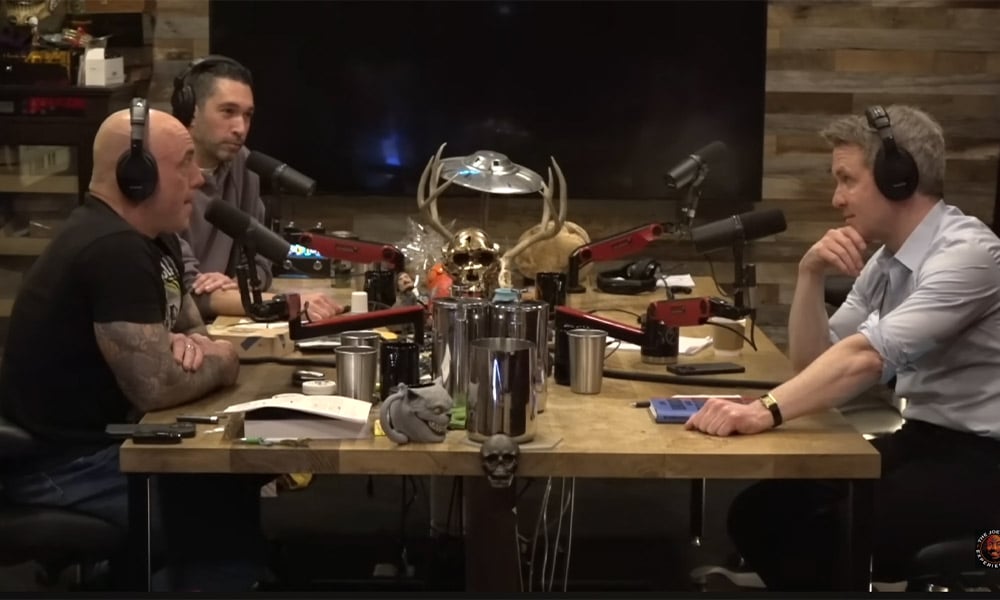
From left to right: Joe Rogan, Dave Smith and Douglas Murray on The Joe Rogan Experience in April 2025. Credit: Youtube Screenshot
Murray rejected the idea that a comedian with a big audience automatically gets to present himself as a credible source on the Middle East. Sitting across Rogan’s table from Smith, Murray said it was “pretty hard to listen to somebody who says, ‘I don’t know what I’m talking about, but now I’m going to talk.’ If you throw a lot of shit out there, there’s some point at which ‘I’m just raising questions’ is not a valid thing. You’re not raising questions. You’re telling people something…Dave’s a comedian, but he’s now mainly talking about Israel.”
“I don’t know about ‘mainly talking about Israel,’ but I have opinions,” Smith replied.
Smith contended that it was reasonable for him, like any American, to talk about his government’s positions: “What’s all the ‘appeal to authority’ stuff, like, you think you have to be an expert?”
Murray wasn’t having it, accusing Smith of playing a “double game” in which a comedian pushes “really edgy and sometimes horrific opinions,… and then, if you say, ‘That’s wrong,’ they say, ‘I’m a comedian, I’m just a comedian.’”
On and on they went, slashing at each other over what is, after all, the central question of the digital revolution: What are truth and accuracy in the internet age? Whose speech should matter about the core questions of the day?
Murray implored Smith to use his influence judiciously. “We live in an era where podcasters have a lot of power,” he said. “I think it’s weird to mainstream very fringe views, constantly, and not give another side.”
Smith agreed that some on the far right have “embraced racialism and it’s dangerous,” but he argued that people like Jake Shields gravitate to Holocaust denial because “you wake up to realize that so much of what you believe was bullshit propaganda and all lies…Once people realize that, they go, ‘Well, what else have they been lying to me about?’”
Murray sneered at Smith for presenting himself as a knowledgeable source on the Israeli-Palestinian conflict without ever having set foot in the region. Smith replied that it takes no expertise to recognize that “when you slaughter innocent people, those people around them tend to hate your guts.”
“Every single conflict of this kind will involve killing innocents,” Murray replied.
In the end, Murray accused Smith of playing with fire by showcasing far-right extremists who in turn fuel an army of antisemites. “All of us have some responsibility to know that what we put out there is very carefully watched,” Murray said.
Smith agreed. “I’m Jewish, I love Jewish people,” he said. “I don’t like Jew hatred on Twitter.” But he didn’t stop there. “That being said,” he added, “I also think there’s a lot of real conspiracies.”
***
The Smith-Murray debate highlighted the risks entailed in mixing comedy and politics. Some on the right dinged Murray for sounding like an elitist gatekeeper, but others seconded his critique of comedians who give conspiracy theorists a platform without significant pushback.
That divide on the American right quickly spread beyond the comedy community, especially after Tucker Carlson conducted a similarly unquestioning two-hour interview with Fuentes (which garnered more than 7 million views). The split pitted old-school Republicans, including many evangelical Christians strongly supportive of the U.S.-Israeli alliance, against a growing nationalist, anti-Israel right, with polls showing a rapid and sharp increase in young voters who hold unfavorable views about Israel.
Smith has been a central figure in the debate, particularly after he shifted from wholehearted support for Trump in the 2024 campaign to calling for the president’s impeachment after the United States first bombed Iran last year. When the United States joined Israel to launch the war with Iran in February, Smith declared that Trump had “destroyed” his presidency. Among Jewish comedians, though, Smith has become a magnet for criticism not so much because he opposed the wars in Gaza and Iran, but because he seemed to embrace antisemites.
Ami Kozak, 38, a Modern Orthodox comedian who built a stand-up and podcast career after starting on TikTok, doesn’t begrudge Smith his political views. But Kozak, who speaks out for Israel in his performances, is appalled at Smith’s unwillingness to push back against extremists: “It’s not that he [thinks Nick Fuentes] is not an antisemite; he thinks he is and he just doesn’t mind that much.” If at the end of a show, someone “like Jake Shields feels better about his Jew-hatred and his Israel-hatred,” then the podcaster has made a “morally questionable” choice.
Kozak, who has debated Smith on X, believes performers should mine their own backgrounds for material, as he has in his bits about living in Israel and in his support for Israel’s war in Gaza. But he believes that Smith sometimes uses his Judaism inappropriately; someone who only deploys “their Jewish identity to criticize Israel—if that’s the only time their Jewish identity is relevant to them, then, I’m sorry, that doesn’t count. Just because I’m Jewish doesn’t mean my pro-Israel stance is valid. And Dave’s anti-Israel stance is not validated by his Judaism either.”
At Dworman’s Comedy Cellar, polemics masquerading as jokes—no matter which political view they favor—don’t work, the owner says. The audience is there for laughs, not for liberal or conservative talking points. Dworman welcomes comedians of any political perspective and jokes on almost any topic. “Nothing should be off limits,” he says. “But people can be very fragile these days. In the club, that’s usually not a problem because people come there to laugh and they expect comedians to cross the line. But not everything has to be made fun of. An ongoing war is a tough one. I’m pro-Israel, but I don’t want to hear jokes about Palestinians dying.”
Comedy, in the end, is about what makes people laugh. But what happens when different audiences start to laugh only at certain material? In a lonely nation of people still edging their way back from pandemic-driven isolation, the craving for laughter—and iconoclasm—is palpable. In comedy as in politics, the urge to connect is everything. If there were some magic formula to making material work, everyone would be a comedian.
The post The Bros of Comedy appeared first on Moment Magazine.