Cruise ship linked to rare hantavirus deaths leaves Cape Verde under tight health controls
A luxury expedition cruise ship linked to a deadly hantavirus outbreak has departed Cape Verde for Spain after three passengers, including two critically ill individuals, were evacuated for specialist treatment in Europe.
 Black News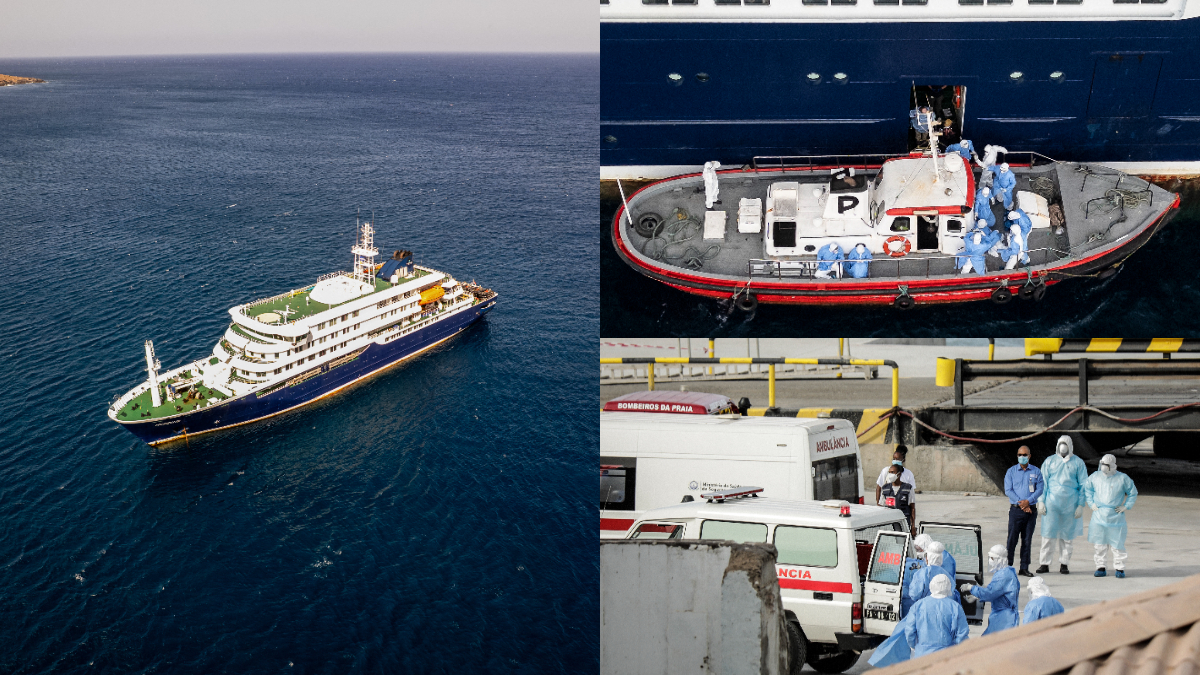
![The MV Hondius cruise ship leaves Cape Verde under health restrictions after a deadly Andes hantavirus outbreak killed three passengers and triggered international quarantine measures. [Photo by AFP via Getty Images]](https://ocdn.eu/pulscms/MDA_/a5c0c9c223d2b2f9bc822ef8bc12d318.jpg)
A luxury expedition cruise ship linked to a deadly hantavirus outbreak has departed Cape Verde for Spain after three passengers, including two critically ill individuals, were evacuated for specialist treatment in Europe.
- A luxury expedition cruise ship linked to a rare hantavirus outbreak has departed Cape Verde for Spain after multiple deaths and emergency evacuations.
- Health authorities across Europe, Africa and South America are tracing passengers following fears linked to the Andes strain of the virus.
- The WHO says the risk to the wider public remains low, stressing that human-to-human transmission is extremely rare.
- The incident has intensified scrutiny of cross-border health responses involving tourism, aviation and maritime travel.
The MV Hondius, operated by Oceanwide Expeditions, left the West African archipelago on Wednesday after being held offshore since Sunday because Cape Verdean authorities refused to allow passengers to disembark following the outbreak.
The vessel, carrying nearly 150 passengers and crew, is expected to arrive in Tenerife in Spain’s Canary Islands within three days. Spain’s Health Minister, Monica Garcia, said passengers remaining on board were not currently showing symptoms.
“Once in Tenerife, if they are still healthy, all non-Spanish citizens will be repatriated to their countries,” Garcia told reporters in Madrid.
Spain said its 14 citizens aboard the ship would be quarantined at a military hospital in Madrid. Authorities said the quarantine period would depend on the timing of possible exposure because the virus can incubate for up to 45 days.
![The MV Hondius cruise ship leaves Cape Verde under health restrictions after a deadly Andes hantavirus outbreak killed three passengers and triggered international quarantine measures. [Photo by AFP via Getty Images]](https://ocdn.eu/pulscms/MDA_/c73f5f02aafcfa666ea6d9824d960f69.jpg)
The outbreak has so far resulted in three deaths, including a Dutch couple and a German passenger. The World Health Organisation said eight people were suspected of having the infection, with three cases confirmed by laboratory testing.
Among those evacuated were a Dutch citizen, a German national and a British passenger, according to Dutch authorities. WHO Director-General Tedros Adhanom Ghebreyesus said they were being transferred to the Netherlands for treatment.
The evacuations were further complicated when Morocco reportedly denied permission for a medical aircraft to refuel en route to Amsterdam. Spain’s health ministry said the plane instead diverted to Gran Canaria, where doctors later reported problems with a patient’s life-support system. The patient was subsequently connected to the airport’s power supply while awaiting another aircraft.
The outbreak has drawn international attention because the strain identified is the Andes variant of hantavirus, one of the few forms known to spread between humans under rare circumstances.
South Africa’s health ministry said the Andes strain can be transmitted only through “very close contact”, such as sharing sleeping quarters or prolonged caregiving. WHO officials stressed that the public health risk remained low.
![The MV Hondius cruise ship leaves Cape Verde under health restrictions after a deadly Andes hantavirus outbreak killed three passengers and triggered international quarantine measures. [Photo by AFP via Getty Images]](https://ocdn.eu/pulscms/MDA_/7e5258cdc085234958046426c59f2fe6.jpg)
“So when we say close contact, we mean very close physical contact,” said Maria Van Kerkhove. “That is very, very different to COVID and very different to influenza.”
Health agencies across several countries have begun tracing passengers and contacts linked to the voyage.
South Africa said it had identified 65 people who may have had contact with confirmed or suspected cases, while other countries had traced an additional 12 people.
Argentina has also launched investigations in Ushuaia, the southern city where the ship began its voyage on April 1.
Authorities are conducting rodent trapping and laboratory analysis while reconstructing the travel routes of infected passengers who had travelled through Argentina and Chile before boarding the ship.
![The MV Hondius cruise ship leaves Cape Verde under health restrictions after a deadly Andes hantavirus outbreak killed three passengers and triggered international quarantine measures. [Photo by AFP via Getty Images]](https://ocdn.eu/pulscms/MDA_/0fe19fa20f81daeae8083342b6203680.jpg)
The vessel travelled through remote destinations, including the British territory of Saint Helena in the South Atlantic. Dutch authorities said about 40 passengers disembarked there, including a Swiss national who later developed symptoms and is now receiving treatment in Zurich.
The incident has also unsettled residents in Tenerife, where the ship is expected to dock. Some locals expressed concerns about the vessel's arrival despite reassurances from global health authorities.
Passenger Kasem Hato told Reuters that life aboard the ship had remained relatively calm despite the restrictions.
“People are taking the situation seriously but without any panic,” he said. “Our days have been close to normal, just waiting for authorities to find a solution.”