Half of Somalia’s young children face malnutrition as famine risk returns after 4 years
Parts of southern Somalia are sliding toward famine again as failed rains, rising food prices and deep cuts in humanitarian aid leave millions struggling to survive, according to new assessments by global hunger monitors and aid agencies.
 Black News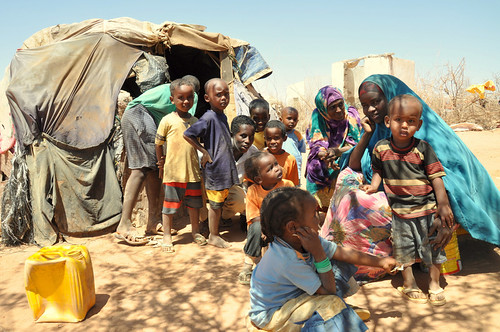
![Children wait for food assistance at a displacement camp in southern Somalia, where aid agencies warn famine risks are rising again. [OneCampaign]](https://ocdn.eu/pulscms/MDA_/652c46aef53c182bc2b336f61902a5b6.jpg)
Parts of southern Somalia are sliding toward famine again as failed rains, rising food prices and deep cuts in humanitarian aid leave millions struggling to survive, according to new assessments by global hunger monitors and aid agencies.
- Southern Somalia is edging toward famine as drought, rising food prices and shrinking aid leave more than 6 million people facing acute hunger.
- Nearly 1.9 million Somalis are already at emergency hunger levels, while severe child malnutrition is rapidly worsening.
- Burhakaba district has been placed under a formal famine-risk warning, the first such alert since Somalia’s 2022 drought crisis.
- Aid groups warn that without urgent funding and better rains, parts of the country could slip into full-scale famine in the coming months.
New data from the U.N.-backed Integrated Food Security Phase Classification (IPC) shows that more than 6 million people in Somalia, roughly one in three residents, are experiencing acute food insecurity.
Of those, about 1.9 million face emergency hunger levels that require urgent intervention.
Children are bearing the heaviest burden. The report estimates that more than 1.88 million children under the age of five are suffering from acute malnutrition, including nearly 493,000 cases classified as severe acute malnutrition, the deadliest form of hunger.
The figure represents an increase from projections released earlier this year.
The worsening conditions have pushed Burhakaba district in Somalia’s Bay region into a formal famine-risk classification through June 2026, the first such warning issued in the country since the devastating drought crisis of 2022.
Under international famine standards, the designation signals extremely dangerous conditions in which large numbers of households face severe food shortages, acute child malnutrition rises sharply and deaths linked to hunger begin increasing rapidly.
Somalia has long remained one of the world’s most fragile food security hotspots because of recurring droughts, armed conflict and widespread poverty.
The country suffered a famine in 2011 that killed about 250,000 people, according to U.N. estimates, and narrowly avoided similar catastrophes in both 2017 and 2022 after large-scale international intervention.
Aid agencies now warn that another crisis may be unfolding as global humanitarian funding weakens at a critical moment.
The IPC said humanitarian support has increased in recent months but still reaches only a fraction of people in need. U.N. figures show humanitarian funding for Somalia stands at around $160 million in 2026, far below the roughly $531 million recorded last year and dramatically lower than the more than $2 billion mobilised during the 2022 drought response.
Analysts say the crisis has been worsened by multiple failed rainy seasons, conflict-driven displacement and surging food prices linked partly to instability in the Middle East.
The depreciation of the Somali shilling in southern regions has also made basic food items harder to afford for many households.
FEWS NET, the U.S.-funded famine early warning system, said the situation could deteriorate quickly if upcoming seasonal rains fail again.
“If the harvest fails, Famine could rapidly emerge in these areas,” FEWS NET spokesperson Hannah Button said, referring to agro-pastoral communities in the Bay, Bakool and Gedo regions.
Save the Children said many families have already exhausted their coping mechanisms after years of repeated climate shocks.
Suad, a 45-year-old mother living in a displacement camp outside Kismayo after fleeing drought and conflict, described worsening conditions for families in the camp.
“The situation is very dire. We have nothing to eat. We have nothing to sleep on and cover ourselves at night,” she said. “You see my small child has even burned himself on the hands while trying to look for something to eat in other houses in the camps.”
Mohamed Mohamud Hassan, country director for Save the Children in Somalia, warned that time is running out to prevent a wider catastrophe.
“Somalia is in the grip of a deepening humanitarian catastrophe,” he said. “The window to prevent famine in Burhakaba and wider deterioration across Somalia is closing fast.”
Humanitarian groups are calling for emergency funding to expand food assistance, nutrition treatment and healthcare services, while also investing in long-term resilience programmes aimed at reducing the country’s repeated dependence on crisis aid.