Survivors stuck in danger
Khalika settlement in Soche Hill is not traceable on your official map, but it is a famous danger zone in Chilobwe Township, Blantyre. On the southern margins of Blantyre City, tongues still wag about the death of over 100 people on March 11 2023 when Cyclone Freddy dumped flashfloods and mudslides in steep slopes. A … The post Survivors stuck in danger appeared first on Nation Online.
 Black News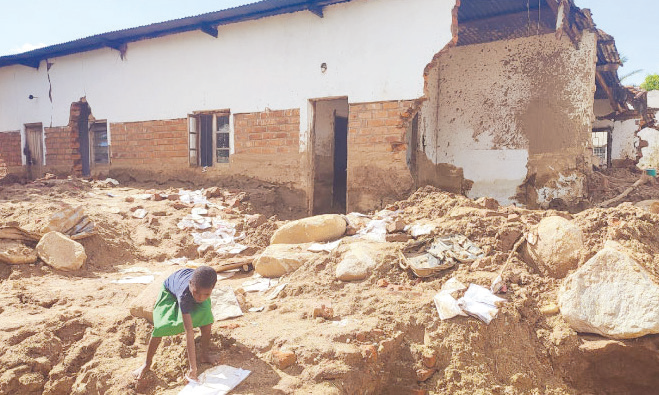
Khalika settlement in Soche Hill is not traceable on your official map, but it is a famous danger zone in Chilobwe Township, Blantyre.
On the southern margins of Blantyre City, tongues still wag about the death of over 100 people on March 11 2023 when Cyclone Freddy dumped flashfloods and mudslides in steep slopes.
John Suwedi has lived on the landslide-prone hillside since 1981.
Locals call him Mr Khalika, a living encyclopaedia of the community’s transformation from an informal settlement in a protected forest to a storied disaster zone with massive rocks hanging loosely over homes under reconstruction.
From scarred valleys to scattered rocks, Freddy’s trail of destruction has defied unhurried reconstruction. Three years on, the battered hills, valleys and floodplains have not recovered yet.
“The eroded slopes and temporary homes offer little hope and protection against the next storm,” says Suwedi. “When we see large dark clouds, we know the sky is moody again. We stay awake, waiting to hear if the hill would move again.”
The old-timer stutters in low tones when giving flashbacks of the rainstorm that claimed 679 lives, with 530 still missing. The World Meteorological Organisation estimates that the cyclone unleashed six months rainfall in just six days.
Today, storm clouds trigger fear and deathly memories of the relentless torrents that soaked Soche Hill three years ago, leaving rocks and mud pounding homes downhill.
“There was nowhere to run and Suwedi lost 18 neighbours,” says the old-timer.
He was speaking in a shadow of a boulder that supposedly crashed his neighbour and his entire family.
His neighbour Laudon Mkandawire says: “We are ready to vacate this place.
“Authorities think that we are resisting, yet the government has not fulfilled its promises to identify safe land for us.”
The cyclone relegated Khalika to a temporary settlement with no water taps or boreholes.
The locals fetch water from streams opened by Cyclone Freddy in valleys and footpaths that split the community.
Beside these symbols of destruction and deprivation, roads remain in disrepair as some survivors rebuild in the disaster zones.
Khalika’s scarred face resembles the situation in Chikwawa District, about 45 kilometres away, where floods frequently displace communities.
The displaced population sheltered at Namichirini Camp in Traditional Authority Lundu use fishing canoes to shuttle between their cut-off villages and temporary shelters.
“We stopped fishing to concentrate on moving people and goods,” said Jenga Mwale, rowing his boat in floodwater.
Floods frequently destroy homes, crops, livestock and other essentials.
“How do you plan your life or rebuild when you know the water will come again and wash away everything?” asks group village head Robert.
The dilemma amplifies calls for survivors to vacate lowlands for areas where they can withstand climate shocks.
The community leader says the promised relocation has “long gone unfulfilled”.
“Our area was declared unsafe and we were told to prepare for relocation, but nothing has happened,” he says.
Section 32 of the Disaster Risk Management Act empowers government to relocate communities from disaster-prone zones to save lives and properties.
The Department of Disaster Management Affairs (Dodma) in 2023 projected that it requires about $680 million to relocate communities in danger, but government has mobilised about half—$376 million—for resettlements and disaster recovery.
Dodma resettled about 5 000 households in Nsanje providing water supply, schools, a health centre and other amenities for those who moved from Makhanga to Osiyana.
Similar relocation happened in Chiradzulu, Mulanje and Phalombe.
“The major challenge is a widening funding gap for relocation, resettlement and recovery,” says Dodma commissioner Wilson Moleni. “Repeated disasters and economic pressures have stretched available resources, making it difficult to meet growing needs.”
Blantyre City Council identified a spot in Mapanga as a new home for Soche Hill dwellers, but the announcement stirred protests by natives.
Authorities say site mapping and plot demarcation are complete, but relocation has stagnated.
Climate campaigner Julius Ng’oma is concerned about sluggish enforcement of disaster reduction laws that prohibit settlements in high-risk zones.
“This creates a cycle where communities fail to fully recover and remain vulnerable to future disasters,” he warns.
The post Survivors stuck in danger appeared first on Nation Online.